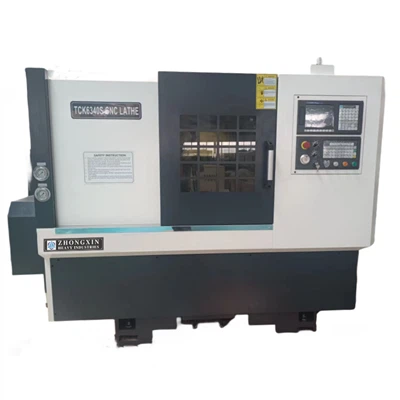
In the dynamic landscape of modern manufacturing, the integration of different pieces of equipment is a topic that has gained significant traction. As a dedicated supplier of CNC lathe machines, I often encounter inquiries from customers about the possibility of integrating these machines with other manufacturing equipment. In this blog post, I will delve into this question, exploring the feasibility, benefits, challenges, and real - world applications of integrating CNC lathe machines with other manufacturing tools.
Feasibility of Integration
The short answer to the question “Can a CNC lathe machine be integrated with other manufacturing equipment?” is a resounding yes. Thanks to advancements in technology, modern CNC lathe machines are designed with a high degree of flexibility and compatibility. Most CNC lathes are equipped with standard interfaces and communication protocols, such as Ethernet, RS - 232, and USB, which allow them to exchange data with other devices.
For example, a CNC lathe can be integrated with a robotic arm. The robotic arm can be programmed to load and unload workpieces from the lathe automatically. This is made possible by the ability of the CNC lathe to communicate its status (such as when a machining operation is completed) to the robotic arm, and vice versa. The robotic arm can then move in sync with the lathe's operations, improving the overall efficiency of the manufacturing process.
Another common integration is with a quality control system. CNC lathes can be connected to coordinate measuring machines (CMMs) or optical inspection systems. After a part is machined on the lathe, it can be automatically transferred to the inspection system. The inspection system then measures the part's dimensions and compares them with the design specifications. If any deviations are detected, the data can be sent back to the CNC lathe, which can then adjust its machining parameters for subsequent parts.
Benefits of Integration
The integration of CNC lathe machines with other manufacturing equipment brings a multitude of benefits.


Increased Productivity
One of the most significant advantages is the boost in productivity. By automating processes such as loading and unloading, and integrating quality control checks, the overall cycle time of manufacturing a part can be significantly reduced. For instance, in a traditional manufacturing setup, an operator might need to manually load a workpiece into the lathe, start the machining process, wait for it to finish, unload the part, and then send it for inspection. With integration, these steps can be carried out seamlessly and continuously, without the need for manual intervention at each stage.
Improved Quality
Integrating CNC lathes with quality control equipment ensures that parts are consistently produced within the required tolerances. Real - time feedback from the inspection system allows for immediate adjustments to the machining process. This reduces the number of defective parts, leading to higher - quality products and lower scrap rates. For example, if a CMM detects that a part's diameter is slightly larger than the specified value, the CNC lathe can adjust its cutting parameters for the next part to correct the issue.
Cost Savings
Over time, the increased productivity and improved quality translate into cost savings. Fewer labor hours are required for manual operations, and the reduction in scrap rates means less waste of raw materials. Additionally, the ability to produce high - quality parts consistently can lead to increased customer satisfaction and potentially more business, further enhancing the company's bottom line.
Challenges of Integration
While the benefits of integration are clear, there are also some challenges that need to be addressed.
Technical Compatibility
One of the main challenges is ensuring technical compatibility between different pieces of equipment. Different manufacturers may use different communication protocols, software interfaces, and data formats. For example, a CNC lathe from one manufacturer may use a proprietary communication protocol, while a robotic arm from another manufacturer uses a different standard. This can make it difficult to establish seamless communication between the two devices.
Initial Investment
Integrating CNC lathe machines with other equipment often requires a significant initial investment. This includes the cost of purchasing additional equipment (such as robotic arms or inspection systems), as well as the cost of implementing the necessary software and hardware for integration. Small and medium - sized enterprises may find it challenging to justify this investment, especially if they are not sure about the long - term benefits.
Training
Employees need to be trained to operate and maintain the integrated system. This includes understanding how to program the different pieces of equipment to work together, as well as troubleshooting any issues that may arise during operation. Training can be time - consuming and costly, and there may be a learning curve before employees can fully utilize the integrated system.
Real - World Applications
There are numerous real - world applications of integrating CNC lathe machines with other manufacturing equipment.
Automotive Industry
In the automotive industry, CNC lathes are often integrated with robotic arms and conveyor systems. Robotic arms load engine components, such as crankshafts and camshafts, into the lathe for machining. After machining, the components are transferred via conveyor belts to other manufacturing stations for further processing or assembly. This integration allows for high - volume production of automotive parts with consistent quality.
Aerospace Industry
The aerospace industry demands high precision and quality in its components. CNC lathes are integrated with advanced inspection systems, such as laser scanners and CMMs. These inspection systems can detect even the slightest deviations in the dimensions of aerospace parts, such as turbine blades. The data from the inspection is then used to fine - tune the machining process on the CNC lathe, ensuring that the parts meet the strict aerospace standards.
Our Offerings
As a supplier of CNC lathe machines, we offer a range of products that are well - suited for integration. Our CNC Lathe Chucks are designed to work seamlessly with our CNC lathes, providing a secure grip on workpieces during machining. Our Ck6140 CNC Lathe is a versatile machine that can be easily integrated with other manufacturing equipment, thanks to its advanced control system and standard communication interfaces. Additionally, our Precision CNC Lathe is ideal for applications where high precision is required, and it can be integrated with quality control systems for accurate part production.
Conclusion
In conclusion, a CNC lathe machine can indeed be integrated with other manufacturing equipment, and the benefits of such integration are substantial. While there are challenges to overcome, the long - term advantages in terms of productivity, quality, and cost savings make it a worthwhile investment for many manufacturing companies.
If you are interested in exploring the possibilities of integrating our CNC lathe machines with your existing manufacturing equipment, or if you have any questions about our products, we encourage you to contact us for a procurement discussion. We are committed to helping you find the best solutions for your manufacturing needs.
References
- Groover, M. P. (2010). Fundamentals of Modern Manufacturing: Materials, Processes, and Systems. Wiley.
- Dornfeld, D. A., Minis, I., & Takeuchi, Y. (2007). Handbook of Manufacturing Engineering and Technology. Springer.
- Stephenson, D. A., & Agapiou, J. S. (2006). Metal Cutting Theory and Practice. CRC Press.