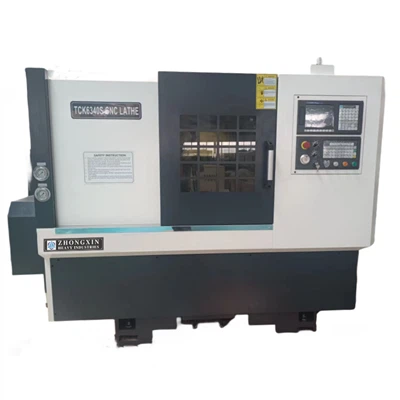
Hey there! As a supplier of Horizontal Turning Lathes, I've been getting a lot of questions about the role of the lead screw in these machines. So, I thought I'd write this blog to break it down for you.
First off, let's talk a bit about Horizontal Turning Lathes in general. These machines are super important in the manufacturing world. They're used to shape and cut different materials, like metal, wood, or plastic, into precise parts. Whether it's making small components for electronics or large pieces for heavy machinery, Horizontal Turning Lathes are up for the task. We offer a range of lathes, including the Small Cnc Lathe, the Ck6140 CNC Lathe, and the New Slant Bed Lathe. Each one has its own features and benefits, but they all rely on some key components to work effectively, and the lead screw is one of them.
So, what exactly is a lead screw? Well, it's a long, threaded rod that plays a crucial role in the movement and operation of the lathe. You can think of it as the "engine" that drives the linear motion of the carriage or the cross-slide on the lathe. The carriage is the part that holds the cutting tool, and the cross-slide allows for movement perpendicular to the axis of the workpiece.
One of the main functions of the lead screw is to control the feed rate of the cutting tool. The feed rate is how fast the cutting tool moves along the workpiece. This is super important because it affects the quality of the cut, the surface finish of the part, and the overall efficiency of the machining process. If the feed rate is too fast, the cutting tool might wear out quickly, or it could leave a rough surface on the workpiece. On the other hand, if the feed rate is too slow, the machining process will take longer, which means lower productivity. The lead screw allows us to adjust the feed rate precisely, depending on the material we're working with, the type of cut we want to make, and the specifications of the part we're producing.
Another important role of the lead screw is in threading operations. Threading is the process of creating screw threads on a workpiece. This is used in a wide range of applications, from making bolts and nuts to creating threaded holes in parts. The lead screw is essential for this because it determines the pitch of the thread. The pitch is the distance between adjacent threads. By rotating the lead screw at a specific speed and in a specific direction, we can control the pitch of the thread we're cutting. This requires a high level of precision, and the lead screw is designed to provide that.
The lead screw also helps with maintaining accuracy and repeatability in the machining process. When we're making multiple parts that need to be identical, we need to be able to reproduce the same cuts and dimensions every time. The lead screw ensures that the movement of the cutting tool is consistent and precise, so we can achieve the same results over and over again. This is especially important in industries where tight tolerances are required, like aerospace or medical device manufacturing.
Now, let's talk about how the lead screw works. It's usually driven by a motor or a gear system. When the motor or gears turn, they rotate the lead screw. The rotation of the lead screw is then converted into linear motion through a nut that's attached to the carriage or the cross-slide. As the lead screw turns, the nut moves along the threads of the screw, causing the carriage or cross-slide to move in a straight line. The design of the threads on the lead screw is very important. They need to be precise and smooth to ensure accurate and efficient movement.
There are different types of lead screws that can be used in Horizontal Turning Lathes. One common type is the Acme lead screw. Acme threads are trapezoidal in shape, which makes them strong and able to handle heavy loads. They're also relatively easy to manufacture, which makes them a cost-effective option. Another type is the ball screw. Ball screws use ball bearings between the screw and the nut to reduce friction and increase efficiency. They're more precise and can handle higher speeds than Acme lead screws, but they're also more expensive.
As a supplier, we understand the importance of having a high-quality lead screw in our Horizontal Turning Lathes. That's why we carefully select the lead screws we use in our machines. We work with trusted manufacturers who have a reputation for producing reliable and precise lead screws. We also test our lathes thoroughly to make sure that the lead screw is working properly and providing the performance we expect.
If you're in the market for a Horizontal Turning Lathe, or if you're looking to upgrade your existing machine, I encourage you to consider the role of the lead screw. It's a small but crucial component that can have a big impact on the performance and quality of your machining operations. Whether you need a lathe for small-scale production or large-scale manufacturing, we have the right solution for you.
If you have any questions about our Horizontal Turning Lathes, or if you'd like to discuss your specific needs and requirements, please don't hesitate to get in touch. We're here to help you find the best machine for your business and to support you throughout the purchasing process.


References
- "Machining Handbook" - A comprehensive guide to machining processes and equipment
- "Lathe Operations Manuals" - Manufacturer-specific manuals that provide detailed information about the operation and maintenance of lathes