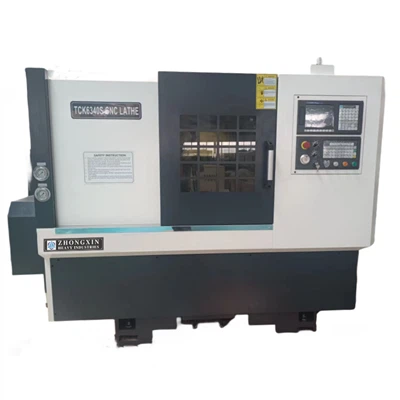
Operating a New CNC Vertical Lathe demands a comprehensive set of skills and knowledge, and as a supplier of these advanced machines, I am well - versed in the training requirements. This blog post will delve into the essential training aspects that operators need to master to efficiently and safely run a New CNC Vertical Lathe.
Basic Machine Familiarization
The first step in training is to familiarize operators with the physical components of the New CNC Vertical Lathe. They need to understand the layout of the machine, including the spindle, tool turret, chuck, and control panel. The spindle is the heart of the lathe, responsible for rotating the workpiece at various speeds. Operators should learn how to set the appropriate spindle speed based on the material and diameter of the workpiece.
The tool turret holds multiple cutting tools, and operators must know how to select the right tool for different machining operations. For example, a roughing tool is used to remove large amounts of material quickly, while a finishing tool is employed for a smooth surface finish. The chuck is used to hold the workpiece securely, and operators should be trained on how to properly install and adjust different types of chucks, such as three - jaw and four - jaw chucks.
The control panel is where operators input commands and parameters. They need to learn the functions of each button and display on the panel. Modern CNC vertical lathes often have touch - screen interfaces, which are more intuitive but still require in - depth training. Operators should be able to navigate through the menu systems, enter part programs, and monitor the machine's status in real - time.
CNC Programming
CNC (Computer Numerical Control) programming is a crucial skill for operating a New CNC Vertical Lathe. Operators need to understand the basic principles of G - code and M - code programming. G - codes are used to control the movement of the cutting tool, such as linear interpolation (G01), circular interpolation (G02 and G03), and rapid positioning (G00). M - codes, on the other hand, are used to control auxiliary functions like spindle start/stop (M03, M05), coolant on/off (M08, M09), and tool change (M06).
There are two main ways to create CNC programs: manual programming and using CAD/CAM (Computer - Aided Design/Computer - Aided Manufacturing) software. Manual programming involves writing G - codes and M - codes directly on the control panel or a computer. This method is suitable for simple parts and small - batch production. However, for complex parts, CAD/CAM software is more efficient. Operators should be trained to use popular CAD/CAM software such as Mastercam, SolidWorks CAM, or Fusion 360. These software packages allow operators to design the part in 3D, define the machining operations, and generate the corresponding CNC program automatically.
Safety Training
Safety is of utmost importance when operating a New CNC Vertical Lathe. Operators need to be trained on the safety procedures and regulations. They should wear appropriate personal protective equipment (PPE), including safety glasses, earplugs, and safety shoes. Long hair should be tied up, and loose clothing should be avoided to prevent entanglement in the moving parts of the machine.
Before starting the machine, operators should perform a pre - start inspection. This includes checking the coolant level, lubrication system, and the integrity of the cutting tools. They should also ensure that the workpiece is properly secured in the chuck and that there are no loose objects in the work area.


During operation, operators should be aware of the potential hazards, such as flying chips, rotating parts, and electrical shock. They should never reach into the working area while the machine is running, and they should know how to stop the machine immediately in case of an emergency. Emergency stop buttons are usually located in prominent positions on the machine, and operators should be trained on their use.
Maintenance and Troubleshooting
Regular maintenance is essential to keep the New CNC Vertical Lathe in good working condition. Operators should be trained on basic maintenance tasks, such as cleaning the machine, lubricating the moving parts, and replacing worn - out cutting tools. They should also know how to check the alignment of the spindle and the tool turret and how to perform simple adjustments.
In addition to maintenance, operators should be able to troubleshoot common problems. For example, if the machine produces poor surface finish on the workpiece, they should be able to identify the possible causes, such as dull cutting tools, incorrect spindle speed, or improper coolant usage. They should also know how to read error messages on the control panel and take appropriate actions to resolve the issues.
Advanced Machining Techniques
Once operators have mastered the basic skills, they can be trained in advanced machining techniques. These techniques can improve the efficiency and quality of the machining process. For example, high - speed machining (HSM) allows operators to remove material at a much faster rate, reducing the machining time. However, HSM requires careful selection of cutting tools, spindle speed, and feed rate to avoid tool breakage and poor surface finish.
Multi - axis machining is another advanced technique. New CNC Vertical Lathes often have multiple axes, such as X, Y, Z, and C axes. Operators should be trained on how to program and operate these multi - axis machines to create complex parts with high precision. For example, 5 - axis machining can be used to machine parts with complex geometries, such as turbine blades and aerospace components.
Simulation and Practice
To reinforce the training, operators should have access to simulation software. Simulation software allows operators to test their CNC programs in a virtual environment before running them on the actual machine. This can help prevent costly mistakes and reduce the risk of damaging the machine or the workpiece.
In addition to simulation, hands - on practice is essential. Operators should be given the opportunity to operate the New CNC Vertical Lathe under the supervision of experienced trainers. They can start with simple parts and gradually move on to more complex ones. Through practice, operators can gain confidence and improve their skills.
Why Choose Our New CNC Vertical Lathe
As a supplier of New CNC Vertical Lathes, we offer high - quality machines that are equipped with the latest technology. Our machines are designed for precision, efficiency, and reliability. We also provide comprehensive training programs for our customers. Our training courses are tailored to the specific needs of the operators, whether they are beginners or experienced machinists.
We have a team of experienced trainers who are experts in CNC machining. They will guide the operators through every step of the training process, from basic machine familiarization to advanced machining techniques. We also offer after - sales support, including maintenance services and technical assistance.
If you are interested in purchasing a New CNC Vertical Lathe or learning more about our training programs, please contact us for a detailed discussion. We are committed to helping you achieve the best results in your machining operations. You can also explore our other products such as Dual Spindle CNC Lathe, Horizontal Turning Lathe, and New CNC Lathe.
References
- "CNC Programming Handbook" by Peter Smid
- "Modern Machining Technology" by Robert L. Norton
- "Fundamentals of Machine Tools and Machining" by Mikell P. Groover