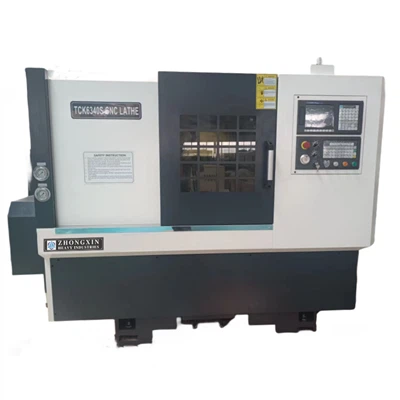
Vibration control in a Swiss Turn Lathe is a crucial aspect that directly impacts the quality of machining operations, tool life, and overall productivity. As a Swiss Turn Lathe supplier, I've witnessed firsthand the significance of effectively managing vibrations in these precision machines.
Understanding the Basics of Vibration in Swiss Turn Lathes
Swiss Turn Lathes are renowned for their ability to produce high - precision, small - diameter parts with great efficiency. However, during the machining process, various factors can induce vibrations. These vibrations can be broadly classified into two types: forced vibrations and self - excited vibrations.
Forced vibrations are typically caused by external forces acting on the lathe. For example, the unbalance of rotating components such as the spindle or cutting tools can generate periodic forces. When the rotational speed of these components approaches the natural frequency of the machine structure, resonance can occur, leading to excessive vibrations. The presence of uneven material in the workpiece can also cause forced vibrations as the cutting tool encounters varying resistance during the cutting process.
Self - excited vibrations, on the other hand, are a result of the interaction between the cutting process and the machine structure. One common form of self - excited vibration is chatter. Chatter is a high - frequency vibration that can severely degrade the surface finish of the workpiece and reduce the accuracy of the machined part. It often occurs when the cutting force and the machine's dynamic response create a feedback loop that amplifies the vibrations.
The Impact of Vibrations on Swiss Turn Lathe Operations
The negative effects of vibrations in Swiss Turn Lathes are far - reaching. Firstly, vibrations can significantly reduce the quality of the machined parts. Excessive vibrations can cause irregularities on the surface of the workpiece, resulting in poor surface finish. This is especially critical in industries where high - precision components are required, such as the medical and aerospace sectors. For instance, in the production of medical implants, a rough surface finish can lead to issues such as increased friction and potential for infection.
Secondly, vibrations take a toll on the cutting tools. The constant shaking can cause premature wear and breakage of the tools. This not only increases the tooling cost but also requires frequent tool changes, which in turn reduces the overall productivity of the machining process. A tool that is subjected to excessive vibrations may also lose its cutting edge, leading to inaccurate cuts and dimensional errors in the workpiece.
Moreover, vibrations can affect the stability and longevity of the Swiss Turn Lathe itself. The continuous stress caused by vibrations can damage the machine's components, such as the bearings, guideways, and spindles. Over time, this can lead to increased maintenance requirements and reduced machine lifespan.
Vibration Control Techniques
Design and Construction
One of the fundamental ways to control vibrations in Swiss Turn Lathes is through proper design and construction. A rigid machine structure can help dampen vibrations. Manufacturers often use high - quality materials with good damping properties, such as cast iron or polymer concrete, in the construction of the lathe bed. These materials can absorb and dissipate the energy generated by vibrations, reducing their amplitude.


The design of the spindle and other rotating components also plays a crucial role. Balancing the spindle and cutting tools is essential to minimize unbalanced forces. Modern Swiss Turn Lathes are equipped with advanced balancing systems that can automatically adjust the balance of the spindle during operation.
Cutting Parameters Optimization
Optimizing the cutting parameters is another effective way to control vibrations. The cutting speed, feed rate, and depth of cut all interact with each other and can influence the occurrence of vibrations. For example, increasing the cutting speed too much can lead to higher cutting forces, which may trigger chatter. On the other hand, a very low feed rate may cause the cutting tool to rub against the workpiece rather than cut it cleanly, also resulting in vibrations.
By carefully selecting the appropriate cutting parameters based on the workpiece material, tool geometry, and machine capabilities, operators can reduce the likelihood of vibrations. This often requires a combination of theoretical knowledge and practical experience. Some Swiss Turn Lathes are now equipped with intelligent control systems that can automatically adjust the cutting parameters in real - time to maintain stable cutting conditions.
Tooling Selection
The choice of cutting tools can also have a significant impact on vibration control. Tools with proper geometry and coating can reduce the cutting forces and improve the chip formation process. For example, a tool with a sharp cutting edge and a suitable rake angle can cut through the workpiece more smoothly, reducing the likelihood of chatter.
Additionally, using anti - vibration toolholders can help dampen vibrations. These toolholders are designed with special damping materials or structures that absorb the energy of the vibrations, preventing them from being transmitted to the machine structure and the workpiece.
Active Vibration Control Systems
In recent years, active vibration control systems have emerged as a powerful tool for vibration control in Swiss Turn Lathes. These systems use sensors to detect vibrations in real - time and actuators to generate counter - vibrations that cancel out the unwanted vibrations.
For example, piezoelectric actuators can be used to apply corrective forces to the machine structure or the cutting tool. By continuously monitoring the vibration signals and adjusting the actuator output, the active vibration control system can maintain a stable cutting process even under challenging conditions.
Our Offerings as a Swiss Turn Lathe Supplier
As a Swiss Turn Lathe supplier, we are committed to providing our customers with machines that incorporate the latest vibration control technologies. Our Swiss Turn Lathes are designed with a rigid and robust structure, using high - quality materials to ensure excellent damping performance.
We offer a wide range of cutting tools and toolholders that are specifically selected for their vibration - reducing properties. Our technical support team can also assist customers in optimizing the cutting parameters for their specific applications, helping them achieve the best possible machining results.
In addition, we provide optional active vibration control systems for our Swiss Turn Lathes. These systems can be easily integrated into the machines, providing an extra layer of protection against vibrations.
If you are in the market for a Swiss Turn Lathe, we also offer related products such as the Ck6140 CNC Lathe, New CNC Lathe, and CNC Lathe Chucks. These products are designed to work seamlessly with our Swiss Turn Lathes, enhancing the overall machining capabilities.
Contact Us for Purchase and Consultation
If you are interested in learning more about our Swiss Turn Lathes and vibration control technologies, or if you have any specific requirements for your machining operations, we encourage you to contact us. Our experienced sales team is ready to provide you with detailed information, answer your questions, and assist you in making the right purchasing decision. We look forward to the opportunity to work with you and help you achieve high - quality, efficient machining operations.
References
- Altintas, Y. (2000). Manufacturing Automation: Metal Cutting Mechanics, Machine Tool Vibrations, and CNC Design. Cambridge University Press.
- Byrne, G., Dornfeld, D., Inasaki, I., Ketteler, G., & Venkatesh, V. C. (2003). Tool wear and surface integrity in machining of nickel - based superalloys: A review. CIRP Annals - Manufacturing Technology, 52(2), 587 - 600.
- Tlusty, J. (2013). Machine Tool Structures: Their Static and Dynamic Behavior. Springer Science & Business Media.