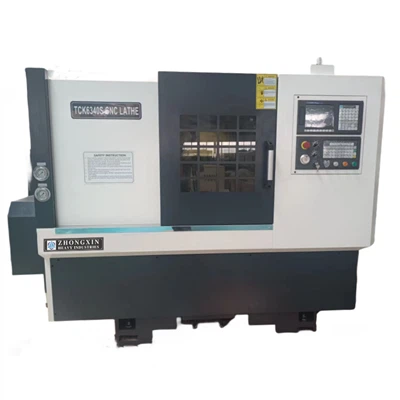
Hey there! I'm a supplier of Gap Bed Engine Lathes, and today I wanna chat about a question that often pops up: Can a Gap Bed Engine Lathe be used for boring large - diameter holes?
Let's start by getting a bit of background on Gap Bed Engine Lathes. These bad boys are pretty versatile machines. A Gap Bed Engine Lathe, like the one you can check out Gap Bed Engine Lathe, has a unique design feature - the gap in the bed. This gap allows for the turning of larger diameter workpieces that wouldn't fit on a standard lathe.
Now, when it comes to boring large - diameter holes, it's not as straightforward as just saying yes or no. There are a few factors we need to consider.
Capabilities of a Gap Bed Engine Lathe for Boring
First off, let's talk about the power and torque. A good Gap Bed Engine Lathe is built with a decent motor that can handle the load of boring operations. When you're boring a large - diameter hole, you're essentially removing a significant amount of material. This requires a machine with enough muscle to turn the cutting tool and push it through the workpiece. Most of the Gap Bed Engine Lathes I supply are equipped with motors that can generate the necessary power to start and maintain the boring process.
The spindle of a Gap Bed Engine Lathe also plays a crucial role. The spindle is responsible for holding the workpiece and rotating it at the desired speed. For boring large - diameter holes, you need a spindle that can handle the weight and size of the workpiece without excessive vibration. A well - balanced spindle ensures that the boring operation is smooth and the hole is accurate. Our Gap Bed Lathe CS6250C has a high - quality spindle that's designed to handle larger workpieces, making it a great option for boring large holes.
Another aspect is the tooling. You can't just use any old tool for boring large - diameter holes. You need a boring bar that's long enough to reach the depth of the hole and strong enough to withstand the cutting forces. Many Gap Bed Engine Lathes come with tool holders that can accommodate different types of boring bars. You can also get custom - made boring bars if you have specific requirements.
Limitations
However, Gap Bed Engine Lathes do have their limitations when it comes to boring large - diameter holes. One of the main issues is the size of the gap. While the gap allows for larger workpieces, there's still a limit to how big a hole you can bore. If the diameter of the hole is too large, it might not fit within the working area of the lathe. You also need to consider the overhang of the boring bar. If the boring bar is too long, it can start to flex during the cutting process, leading to inaccurate holes and poor surface finish.
The accuracy of the lathe is another factor. As the size of the hole increases, it becomes more challenging to maintain the same level of accuracy. Small vibrations or misalignments can have a more significant impact on the final result. So, while a Gap Bed Engine Lathe can be used for boring large - diameter holes, you might need to take extra precautions to ensure the accuracy of the hole.
Applications
Despite the limitations, there are many applications where a Gap Bed Engine Lathe can be effectively used for boring large - diameter holes. In the automotive industry, for example, you might need to bore large holes in engine blocks or transmission housings. A Gap Bed Engine Lathe can handle these types of jobs with relative ease.
In the manufacturing of large machinery, such as agricultural equipment or construction machinery, there are often components that require large - diameter holes. A Gap Bed Engine Lathe can be a cost - effective solution for these applications, especially if you don't need the extreme precision of a dedicated boring machine.
Tips for Boring Large - Diameter Holes
If you're planning to use a Gap Bed Engine Lathe for boring large - diameter holes, here are a few tips. First, make sure you select the right cutting speed and feed rate. The cutting speed depends on the material of the workpiece and the type of cutting tool you're using. A slower cutting speed is usually better for large - diameter holes to reduce the risk of tool wear and vibration.
Second, use a coolant. Coolant helps to reduce the heat generated during the cutting process, which can improve the tool life and the surface finish of the hole.
Finally, take your time. Boring large - diameter holes is a time - consuming process, and rushing it can lead to mistakes. Make multiple passes with the boring bar, gradually increasing the diameter of the hole.
Conclusion
So, can a Gap Bed Engine Lathe be used for boring large - diameter holes? The answer is yes, but with some limitations. It's a versatile machine that can handle many applications, but you need to be aware of its capabilities and take the necessary precautions. If you're in the market for a Gap Bed Engine Lathe for boring large - diameter holes, I'd be more than happy to help you find the right machine for your needs. Whether you're a small - scale manufacturer or a large industrial company, we have a range of Gap Bed Engine Lathes that can meet your requirements.


If you're interested in learning more about our Gap Bed Engine Lathes or have any questions about using them for boring large - diameter holes, don't hesitate to reach out. We can have a chat about your specific needs and see how we can help you get the most out of your machining operations.
References
- "Machining Handbook" - A comprehensive guide on machining processes and machine tools.
- Industry reports on the use of Gap Bed Engine Lathes in different manufacturing sectors.