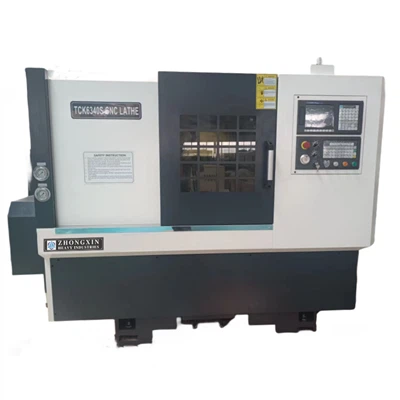
As a supplier of New Vertical Lathes, ensuring the parallelism of machined parts is a crucial aspect of our product's performance. Parallelism refers to the condition where two or more surfaces or axes of a part are equidistant from each other along their entire length. In precision machining, maintaining high parallelism is essential for the proper functioning and assembly of components, especially in industries such as aerospace, automotive, and machinery manufacturing. In this blog, we will explore how our New Vertical Lathes achieve and maintain the parallelism of machined parts.
1. Precision Machine Structure
The foundation of ensuring parallelism starts with the design and construction of the vertical lathe itself. Our New Vertical Lathes are built with a rigid and stable structure. The base of the lathe is made of high - quality cast iron or welded steel, which provides excellent vibration damping and mechanical stability. This stability is vital because any vibration or movement during the machining process can cause deviations in the cutting path, leading to poor parallelism.
The column and cross - slide of the vertical lathe are precisely machined and assembled. Advanced manufacturing techniques, such as precision grinding and honing, are used to ensure that the guiding surfaces of the column and cross - slide have extremely low surface roughness and high geometric accuracy. These guiding surfaces serve as the reference for the movement of the cutting tool and the workpiece, and their high precision directly contributes to the parallelism of the machined parts.
2. High - Precision Spindle System
The spindle is the heart of the vertical lathe, and its performance has a significant impact on the parallelism of machined parts. Our New Vertical Lathes are equipped with high - precision spindle systems. The spindle is supported by high - quality bearings, such as angular contact ball bearings or cylindrical roller bearings. These bearings are carefully selected and pre - loaded to minimize radial and axial run - out.
Radial run - out can cause the cutting tool to move in an irregular circular path, resulting in uneven cutting and poor parallelism of the machined surface. Axial run - out can lead to variations in the depth of cut along the axial direction of the workpiece, also affecting parallelism. By reducing run - out to an extremely low level, our spindle system ensures that the cutting tool rotates accurately around a fixed axis, enabling precise machining and maintaining parallelism.
In addition, the spindle drive system is designed for smooth and stable operation. Variable frequency drives or servo motors are used to control the spindle speed precisely. This allows for consistent cutting conditions, which are essential for achieving parallelism. For example, when machining a long shaft, a stable spindle speed ensures that the cutting force remains constant, preventing any sudden changes that could cause the workpiece to deform and affect parallelism.
3. Accurate Tooling and Tool - Holding Systems
The choice of cutting tools and the tool - holding systems is another key factor in ensuring parallelism. Our New Vertical Lathes are compatible with a wide range of high - precision cutting tools, such as carbide inserts and high - speed steel tools. These tools are designed with sharp cutting edges and precise geometries to ensure clean and accurate cuts.


The tool - holding systems, such as tool holders and tool turrets, are engineered for high rigidity and accuracy. They are designed to hold the cutting tool firmly in place during the machining process, preventing any tool movement or deflection. A well - designed tool - holding system ensures that the cutting tool is positioned accurately relative to the workpiece, which is crucial for maintaining parallelism. For instance, a misaligned tool can cause one side of the machined surface to be cut deeper than the other, resulting in poor parallelism.
We also offer CNC Lathe Chucks that are designed to hold the workpiece securely and precisely. These chucks can be adjusted to ensure that the workpiece is centered accurately on the spindle axis. A centered workpiece is essential for achieving parallelism, as any eccentricity can cause the cutting tool to cut unevenly around the circumference of the workpiece.
4. Advanced Control Systems
Our New Vertical Lathes are equipped with advanced CNC control systems. These control systems allow for precise programming and control of the machining process. The operator can input detailed machining parameters, such as cutting speed, feed rate, and depth of cut, with high accuracy. The control system then ensures that these parameters are maintained throughout the machining process.
For example, when machining a part with multiple parallel surfaces, the control system can be programmed to move the cutting tool along a specific path with a high degree of accuracy. It can also compensate for any small errors or deviations that may occur during the machining process. This is achieved through features such as backlash compensation and tool wear compensation. Backlash compensation corrects for any play in the mechanical transmission system, while tool wear compensation adjusts the cutting parameters to account for the gradual wear of the cutting tool.
The control system also provides real - time monitoring of the machining process. It can detect any abnormal conditions, such as sudden changes in cutting force or spindle speed, and take appropriate actions to prevent damage to the workpiece or the machine. This real - time monitoring helps to ensure that the machining process remains stable and that parallelism is maintained.
5. Calibration and Maintenance
Regular calibration and maintenance are essential for ensuring the long - term parallelism of machined parts on our New Vertical Lathes. We provide comprehensive calibration procedures and tools to our customers. Calibration involves checking and adjusting the geometric accuracy of the machine, including the parallelism of the guiding surfaces, the spindle run - out, and the tool - holding accuracy.
During calibration, precision measuring instruments, such as dial indicators and laser interferometers, are used to measure the machine's accuracy. Any deviations from the specified tolerances are corrected by adjusting the relevant components. For example, if the parallelism of the cross - slide guiding surface is found to be out of tolerance, the slide can be adjusted or re - machined to restore its accuracy.
In addition to calibration, regular maintenance is required to keep the machine in optimal condition. This includes lubricating the moving parts, checking the electrical and hydraulic systems, and replacing worn - out components. A well - maintained machine is less likely to experience mechanical problems that could affect parallelism. For instance, if the lubrication of the guiding surfaces is insufficient, it can cause increased friction and wear, leading to a decrease in the accuracy of the machine's movement and poor parallelism of the machined parts.
6. Application - Specific Considerations
Different applications may require specific techniques to ensure parallelism. For example, when machining large - diameter workpieces, the weight and size of the workpiece can cause deformation. To address this issue, our New Vertical Lathes can be equipped with additional support devices, such as steady rests or center supports. These support devices help to minimize the deflection of the workpiece during machining, ensuring parallelism.
In the case of machining thin - walled parts, the cutting force can cause the part to deform easily. Special cutting strategies, such as using small - depth - of - cut and high - feed - rate machining, can be employed to reduce the cutting force and prevent deformation. The control system can also be programmed to apply intermittent cutting or use vibration - assisted machining techniques to further reduce the cutting force and improve parallelism.
We also offer a variety of models, such as the Ck6132 CNC Lathe and the Swiss Turn Lathe, which are designed for different machining requirements. Each model is optimized to ensure parallelism in its specific application scenarios.
In conclusion, our New Vertical Lathes are designed and engineered to ensure the parallelism of machined parts through a combination of precision machine structure, high - precision spindle systems, accurate tooling and tool - holding systems, advanced control systems, calibration, and maintenance, as well as application - specific considerations. If you are in the market for a vertical lathe that can provide high - quality parallel machining, we invite you to contact us for more information and to discuss your specific requirements. Our team of experts is ready to assist you in finding the best solution for your machining needs.
References
- Smith, J. (2018). Precision Machining Technology. Publisher: ABC Publishing.
- Brown, A. (2019). Advanced CNC Machining: Principles and Applications. Publisher: XYZ Press.
- Johnson, R. (2020). Lathe Design and Operation. Publisher: DEF Books.