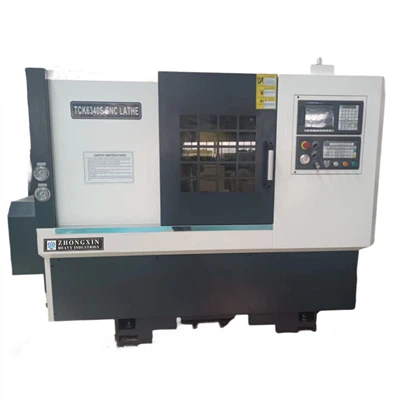
The lead screw is a critical component in the threading operation on a horizontal turning lathe. As a supplier of horizontal turning lathes, I have witnessed firsthand how the performance of the lead screw can significantly impact the quality and efficiency of threading processes. In this blog, I will delve into the various ways the lead screw affects threading operations and why it is essential for manufacturers to understand these dynamics.
Understanding the Role of the Lead Screw in Threading
Threading on a horizontal turning lathe involves the precise movement of the cutting tool along the workpiece to create helical grooves. The lead screw plays a pivotal role in this process by providing the necessary linear motion to the tool carriage. It is connected to the lathe's spindle through a gear train, which ensures that the tool moves at a constant and predictable rate relative to the rotation of the workpiece.
The pitch of the lead screw determines the pitch of the threads being cut. For example, if the lead screw has a pitch of 6 mm, each revolution of the spindle will cause the tool to move 6 mm along the workpiece, resulting in a thread with a pitch of 6 mm. Therefore, selecting the correct lead screw with the appropriate pitch is crucial for achieving the desired thread specifications.
Impact on Thread Quality
The quality of the threads produced on a horizontal turning lathe is directly influenced by the condition and performance of the lead screw. Any irregularities or inaccuracies in the lead screw's motion can lead to defects in the threads, such as inconsistent pitch, poor surface finish, or thread forms that deviate from the design specifications.
One of the primary factors affecting thread quality is the lead screw's accuracy. Over time, the lead screw may wear due to continuous use, resulting in a loss of precision. This can cause the threads to have a variable pitch, which is unacceptable in many applications. To ensure high-quality threads, it is essential to regularly inspect and maintain the lead screw, and replace it when necessary.
Another aspect that affects thread quality is the lead screw's backlash. Backlash refers to the play or clearance between the threads of the lead screw and the nut that drives the tool carriage. Excessive backlash can cause the tool to move erratically, leading to rough and uneven threads. To minimize backlash, manufacturers often use anti-backlash nuts or employ other techniques to ensure a tight fit between the lead screw and the nut.
Influence on Threading Efficiency
In addition to thread quality, the lead screw also has a significant impact on the efficiency of the threading operation. A well-designed and properly maintained lead screw can enable faster and more precise threading, reducing production time and increasing productivity.
The speed at which the lead screw can move the tool carriage is determined by its pitch and the rotational speed of the spindle. By selecting a lead screw with a higher pitch, manufacturers can achieve faster threading speeds, provided that the lathe's spindle can rotate at the required speed. However, it is important to note that increasing the threading speed may also increase the risk of tool wear and reduce the quality of the threads. Therefore, finding the optimal balance between speed and quality is crucial for maximizing efficiency.
Furthermore, the lead screw's ability to provide smooth and consistent motion is essential for efficient threading. Any vibrations or jerks in the lead screw's movement can cause the tool to chatter, resulting in poor surface finish and reduced tool life. To ensure smooth motion, manufacturers often use high-quality lead screws with precision-ground threads and employ advanced lubrication systems to minimize friction.


Compatibility with Different Threading Processes
Horizontal turning lathes are capable of performing various threading processes, such as single-point threading, multi-point threading, and tapping. The lead screw must be compatible with these different processes to ensure optimal performance.
For single-point threading, the lead screw provides the linear motion required to move the cutting tool along the workpiece. The pitch of the lead screw determines the pitch of the threads being cut, and the tool's geometry and cutting parameters must be carefully selected to achieve the desired thread form.
Multi-point threading, on the other hand, involves the use of multiple cutting tools simultaneously to cut multiple threads at once. This process requires a lead screw that can provide precise and synchronized motion to all the cutting tools. The lead screw's accuracy and repeatability are crucial for ensuring that all the threads are cut to the same specifications.
Tapping is another threading process that can be performed on a horizontal turning lathe. In tapping, a tap is used to cut internal threads in a pre-drilled hole. The lead screw must be able to provide the necessary feed motion to the tap, ensuring that it advances at the correct rate to cut the threads accurately.
Importance of Selecting the Right Lead Screw
As a horizontal turning lathe supplier, I understand the importance of selecting the right lead screw for each application. The choice of lead screw depends on several factors, including the required thread pitch, the material being machined, the threading process, and the desired production speed and quality.
When selecting a lead screw, it is essential to consider its accuracy, backlash, and load capacity. High-precision lead screws with low backlash are typically required for applications that demand tight tolerances and high-quality threads. Additionally, the lead screw's load capacity must be sufficient to handle the forces generated during the threading operation without excessive deflection or wear.
In some cases, it may be necessary to customize the lead screw to meet specific requirements. This can involve modifying the pitch, diameter, or length of the lead screw, or using special materials or coatings to improve its performance. As a supplier, I work closely with my customers to understand their needs and provide them with the most suitable lead screw solutions.
Conclusion
In conclusion, the lead screw is a vital component in the threading operation on a horizontal turning lathe. Its performance directly affects the quality, efficiency, and compatibility of the threading process. By understanding the various ways the lead screw affects threading operations, manufacturers can make informed decisions when selecting and maintaining their lathes.
As a [Your Company's Position] at a horizontal turning lathe supplier, I am committed to providing high-quality lathes and lead screw solutions to meet the diverse needs of my customers. Whether you are looking for a New Vertical Lathe, a Fanuc Lathe, or a Ck6150 CNC Lathe, I can offer you expert advice and support to ensure that you get the best results from your threading operations.
If you are interested in learning more about our products or have any questions about threading on horizontal turning lathes, please do not hesitate to contact me. I look forward to discussing your requirements and helping you find the perfect solution for your manufacturing needs.
References
- Smith, J. (2018). "Advanced Machining Processes." McGraw-Hill Education.
- Jones, R. (2019). "CNC Machining Handbook." Industrial Press.
- Brown, A. (2020). "Threading Operations on Lathes." Machining Technology Journal.