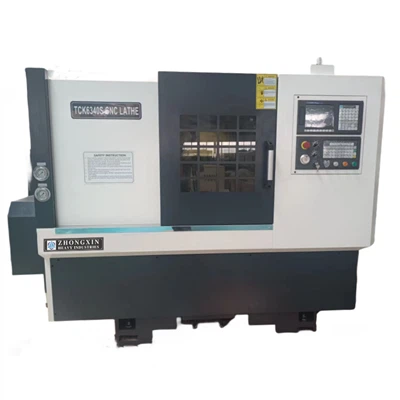
Hey there! As a supplier of New Vertical Lathes, I often get asked about the backlash compensation mechanism of these machines. So, I thought I'd take the time to break it down for you in a way that's easy to understand.


First off, let's talk about what backlash is. In a lathe, backlash refers to the play or clearance between the moving parts, like the lead screw and the nut. When you change the direction of the feed, this clearance can cause a small delay or movement in the opposite direction before the actual cutting starts. This can lead to inaccuracies in your machining, especially when you're working on precision parts.
The backlash compensation mechanism in a New Vertical Lathe is designed to minimize or eliminate this problem. It works by detecting the direction change of the feed and then making a small adjustment to the position of the cutting tool to compensate for the backlash. This ensures that the tool moves exactly where it's supposed to, every time.
There are a few different ways that backlash compensation can be implemented in a New Vertical Lathe. One common method is through the use of a servo motor and a feedback system. The servo motor is responsible for driving the lead screw, and the feedback system monitors the position of the tool. When a direction change is detected, the servo motor adjusts the position of the lead screw to compensate for the backlash.
Another method is through the use of a mechanical device, such as a spring-loaded nut or a preloaded ball screw. These devices help to reduce the clearance between the moving parts and provide a more rigid connection. This can help to minimize the effects of backlash and improve the accuracy of the machining.
So, why is backlash compensation so important in a New Vertical Lathe? Well, for starters, it can significantly improve the quality of your finished parts. By eliminating the inaccuracies caused by backlash, you can ensure that your parts meet the exact specifications and tolerances required by your customers. This can lead to higher customer satisfaction and repeat business.
In addition, backlash compensation can also increase the efficiency of your machining process. By reducing the amount of time and effort required to correct for inaccuracies, you can save both time and money. This can help to improve your bottom line and make your business more competitive in the market.
Now, let's take a look at some of the benefits of using a New Vertical Lathe with backlash compensation. One of the biggest advantages is the ability to achieve higher levels of precision. With backlash compensation, you can machine parts with extremely tight tolerances, which is essential for many industries, such as aerospace, automotive, and medical.
Another benefit is the improved surface finish of your parts. By eliminating the vibrations and inaccuracies caused by backlash, you can achieve a smoother and more consistent surface finish. This can enhance the appearance and functionality of your parts and make them more appealing to your customers.
In addition, a New Vertical Lathe with backlash compensation is also more reliable and durable. By reducing the wear and tear on the moving parts, you can extend the lifespan of the machine and reduce the need for frequent maintenance and repairs. This can save you both time and money in the long run.
If you're in the market for a New Vertical Lathe, I highly recommend considering a machine with backlash compensation. It's a feature that can make a big difference in the quality and efficiency of your machining process. And if you're looking for more information about precision CNC lathes, CNC lathe chucks, or the best small CNC lathes, be sure to check out these links: Precision CNC Lathe, CNC Lathe Chucks, Best Small Cnc Lathes.
So, there you have it! That's a brief overview of the backlash compensation mechanism of a New Vertical Lathe. If you have any questions or would like to learn more about our products, please don't hesitate to contact us. We'd be happy to help you find the right machine for your needs and answer any questions you may have.
References
- "CNC Machining Handbook" by John A. Schey
- "Precision Machine Design" by Wayne A. Moore
- "Machine Tool Practices" by Robert L. Norton