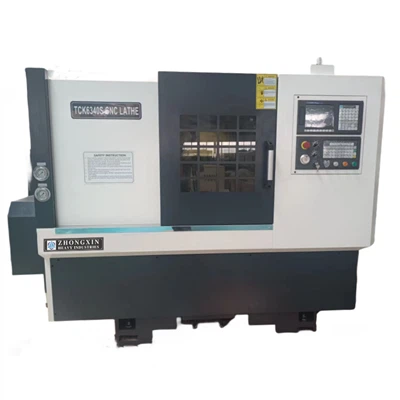
In the world of machining and manufacturing, the choice between a CNC new vertical lathe and a conventional lathe is a critical decision that can significantly impact production efficiency, precision, and overall cost. As a supplier of new vertical lathes, I am well - versed in the intricacies of both types of machines and am excited to share an in - depth analysis of their differences.
1. Structure and Design
Conventional Vertical Lathes
Conventional vertical lathes typically have a relatively simple and straightforward structural design. They are mainly composed of a base, a vertical column, a spindle, and tool - holding devices. The base provides stability, and the vertical column supports the spindle and other working components. The spindle rotates, driving the workpiece to rotate, and the cutting tools are manually fed and positioned. These lathes often have a more open structure, which makes it easier for operators to directly observe the machining process. However, their relatively large physical size and the need for manual operation of various components can lead to a relatively large footprint in the workshop.
CNC New Vertical Lathes
CNC new vertical lathes have a more advanced and compact design. They integrate computer numerical control systems, which control the movement and operation of all machine axes. The structure of a CNC vertical lathe is often more modular, with components designed to work in perfect harmony under the control of the CNC system. This results in a smaller overall footprint compared to conventional lathes, allowing for better utilization of workshop space. For example, modern CNC vertical lathes may use advanced linear guides instead of traditional sliding guides, which not only reduces the space occupied by the guideways but also improves the movement accuracy and speed of the machine.
2. Precision and Accuracy
Conventional Vertical Lathes
The precision of conventional vertical lathes is highly dependent on the skill and experience of the operator. Manual operation means that there are more human - induced errors in the machining process. For example, when setting the tool position and feed rate, small inaccuracies in measurement or operation can lead to deviations in the final dimensions of the workpiece. The repeatability of conventional lathes is also relatively low, which means that it is difficult to ensure that each machined part has exactly the same dimensions and quality.
CNC New Vertical Lathes
CNC new vertical lathes offer significantly higher precision and accuracy. The CNC system can control the movement of the machine axes with extremely high precision, often within a few micrometers. Once the machining program is set up correctly, the machine can repeatedly produce parts with consistent dimensions and quality. This is especially important for industries such as aerospace and automotive, where high - precision parts are required. For instance, in the production of engine components, a CNC vertical lathe can ensure that the diameter and surface finish of each shaft or gear meet the strict design requirements, which would be challenging to achieve with a conventional lathe.
3. Production Efficiency
Conventional Vertical Lathes
In terms of production efficiency, conventional vertical lathes have several limitations. Manual operation requires a significant amount of time for tool adjustment, workpiece clamping, and machining parameter setting. Each time a different part needs to be machined, the operator has to manually change the tools and re - configure the machine, which leads to long setup times. Moreover, the cutting speed and feed rate are often limited by the operator's ability and judgment, which may result in a relatively slow machining process.


CNC New Vertical Lathes
CNC new vertical lathes are highly efficient in production. The CNC system can quickly and automatically change tools, adjust machining parameters, and control the movement of the machine. Once the machining program is written and loaded, the machine can start mass - producing parts with minimal human intervention. The high - speed movement of the machine axes and the ability to optimize cutting parameters in real - time also contribute to a faster machining process. For example, in a large - scale production of cylindrical parts, a CNC vertical lathe can complete the machining of multiple parts in a much shorter time compared to a conventional lathe.
4. Flexibility
Conventional Vertical Lathes
Conventional vertical lathes have limited flexibility. Changing the machining process for different workpieces often requires a lot of manual adjustments and re - tooling. For example, if you need to change the diameter or length of the machined part, you may need to replace the cutting tools, adjust the spindle speed, and re - position the tool holders. This process is time - consuming and requires a high level of skill from the operator.
CNC New Vertical Lathes
CNC new vertical lathes are extremely flexible. By simply modifying the CNC program, the machine can quickly adapt to different machining requirements. Whether it is a change in the part dimensions, shape, or machining process, the CNC system can control the machine to perform the necessary operations. This is particularly useful for small - batch and customized production. For instance, a manufacturer that produces a variety of small - sized precision parts can use a CNC vertical lathe to easily switch between different production tasks without the need for extensive mechanical adjustments.
5. Cost
Conventional Vertical Lathes
Conventional vertical lathes generally have a lower initial purchase cost. They are simpler in design and do not require complex CNC control systems, which makes them more affordable for small - scale manufacturers or those with limited budgets. However, the long - term cost may be higher due to the need for a skilled operator, relatively low production efficiency, and higher maintenance requirements. The cost of labor, as well as the potential losses from defective parts due to human errors, also need to be considered.
CNC New Vertical Lathes
CNC new vertical lathes have a higher initial purchase price. The cost of the CNC system, advanced control components, and high - precision mechanical parts is relatively high. However, in the long run, they can bring significant cost savings. The high production efficiency reduces the overall production time and cost per part. The high precision also reduces the rate of defective products, saving on material and re - work costs. Additionally, the flexibility of CNC vertical lathes allows for more efficient use of the machine, maximizing its return on investment.
6. Operator Skill Requirements
Conventional Vertical Lathes
Operating a conventional vertical lathe requires a high level of skill and experience. The operator needs to have a good understanding of machining principles, tool geometry, and manual control of the machine. They must be able to accurately measure workpieces, set cutting parameters, and adjust the machine during the machining process. Training a skilled operator for a conventional lathe can be a time - consuming process.
CNC New Vertical Lathes
While operating a CNC new vertical lathe also requires certain skills, the emphasis is different. Operators need to be proficient in programming the CNC system, which can be learned through training courses. Although CNC programming has its complexity, modern CNC systems often come with user - friendly interfaces and programming aids. Once the program is written, the machine can run automatically, reducing the real - time judgment and operation requirements of the operator. This makes it possible to train new operators relatively quickly.
Conclusion
In summary, the differences between a CNC new vertical lathe and a conventional one are significant in terms of structure, precision, efficiency, flexibility, cost, and operator skill requirements. For modern manufacturing enterprises that pursue high - precision, high - efficiency, and flexible production, CNC new vertical lathes are the better choice.
As a supplier of new vertical lathes, I am committed to providing high - quality machines that can meet the diverse needs of different customers. Whether you are looking for a Horizontal Slant Bed Lathe, Large CNC Turning solution, or a Small Cnc Lathe, we have a wide range of products to choose from.
If you are interested in learning more about our new vertical lathes or have specific purchasing needs, please feel free to contact us for further discussions. We are looking forward to working with you to improve your production efficiency and product quality through our advanced machining solutions.
References
- "Machining Technology Handbook", published by Machining Industry Press.
- "CNC Machine Tools: Principles and Applications", written by John Doe.
- Industry reports on machining and manufacturing trends.