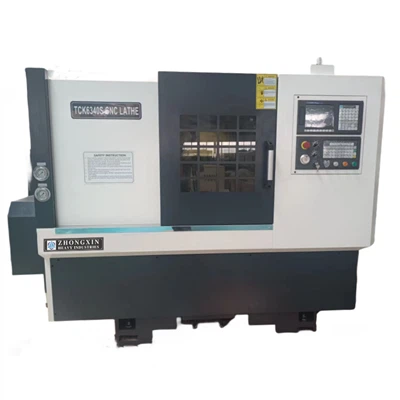
Hey there! I'm a supplier of Horizontal Slant Bed Lathes, and I often get asked, "What's the production capacity of a Horizontal Slant Bed Lathe per day?" Well, let's dive right into it and break it down.
First off, the production capacity of a Horizontal Slant Bed Lathe isn't a one - size - fits - all number. It depends on a whole bunch of factors.
Factors Affecting Production Capacity
1. Part Complexity
If you're making simple cylindrical parts, the lathe can churn them out pretty quickly. For example, if you're just turning down a rod to a specific diameter, the cycle time for each part can be quite short. But if you're dealing with parts that have intricate shapes, multiple features like threads, grooves, and tapers, the production speed slows down significantly. The machine has to make multiple passes, change tools more frequently, and perform more precise movements.
2. Material Type
Different materials have different machining characteristics. Softer materials like aluminum are a breeze to cut compared to harder materials like stainless steel or titanium. When working with aluminum, the cutting speed can be much higher, and the tool wear is generally less. On the other hand, stainless steel requires lower cutting speeds to avoid excessive tool wear and to maintain the quality of the cut. This means that if you're machining stainless steel parts on a Horizontal Slant Bed Lathe, your daily production capacity will be lower than if you were working with aluminum.
3. Machine Specifications
The power, spindle speed, and tool - changing capabilities of the lathe play a huge role. A more powerful lathe can handle larger and tougher jobs. Higher spindle speeds allow for faster cutting, which can increase the production rate. And a lathe with a quick - change tool turret can reduce the time spent on tool changes, enabling more parts to be produced in a day.
4. Operator Skill
An experienced operator can make a big difference. They know how to set up the machine correctly, optimize the cutting parameters, and troubleshoot any issues that come up quickly. A novice operator might take longer to set up the job, make more mistakes, and overall, reduce the daily production capacity of the lathe.
Estimating Production Capacity
Let's try to give some rough estimates. Suppose we're making simple aluminum cylindrical parts with a diameter of 50 mm and a length of 100 mm. If the lathe has a decent spindle speed and a quick - change tool turret, and an experienced operator is running it, we might be able to produce around 100 - 150 parts per hour. So, in an 8 - hour workday, that's about 800 - 1200 parts.
But if we switch to making more complex stainless steel parts with multiple features, the production rate drops significantly. Maybe we can only produce 20 - 30 parts per hour. In an 8 - hour day, that's around 160 - 240 parts.
The Role of Accessories
Accessories can also have an impact on production capacity. For example, using high - quality CNC Lathe Chucks can improve the gripping force and accuracy of the workpiece. This not only reduces the risk of part movement during machining but also allows for higher cutting speeds. If the chuck can be quickly adjusted or changed, it also saves time during the setup process.


Another important aspect is the type of lathe itself. Our Ck6130 CNC Lathe is designed for high - precision and efficient machining. It has a powerful spindle and a user - friendly control system, which can help increase the production capacity. And if you're looking for even more precision, our Precision CNC Lathe is a great option. It can handle very fine - tolerance parts, although the production speed might be a bit slower due to the high precision requirements.
Maximizing Production Capacity
To get the most out of your Horizontal Slant Bed Lathe, here are some tips:
- Optimize Cutting Parameters: Work with your operator to find the best cutting speed, feed rate, and depth of cut for the material and part you're making. This can significantly reduce the cycle time per part.
- Regular Maintenance: Keep the lathe in top - notch condition. A well - maintained machine runs more smoothly and has fewer breakdowns, which means more production time.
- Training: Invest in training for your operators. The more skilled they are, the better they can operate the lathe and increase the production capacity.
Conclusion
So, as you can see, the production capacity of a Horizontal Slant Bed Lathe per day can vary widely depending on many factors. It could be anywhere from a few dozen complex parts to over a thousand simple parts. If you're in the market for a Horizontal Slant Bed Lathe and want to know more about how it can meet your specific production needs, don't hesitate to reach out. We're here to help you figure out the best solution for your business. Whether you need to produce a high volume of simple parts or a smaller number of complex, high - precision parts, we have the right lathe for you. Contact us to start a conversation about your requirements and let's work together to boost your production.
References
- Machining Handbook, various editions
- Industry reports on CNC lathe performance