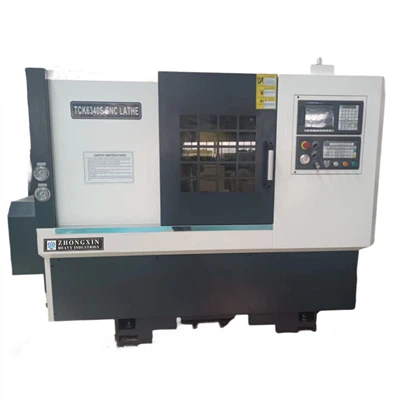
In the realm of precision machining, Swiss Turn Lathes stand out as a cornerstone technology, renowned for their ability to produce high - precision components with remarkable efficiency. As a supplier of Swiss Turn Lathes, I am often asked about the repeatability of these machines, a topic that is not only crucial for understanding their performance but also for making informed decisions in manufacturing processes.
Understanding Repeatability in Swiss Turn Lathes
Repeatability, in the context of a Swiss Turn Lathe, refers to the machine's ability to produce multiple parts with consistent dimensions and quality over time. It is a measure of how closely the lathe can reproduce the same machining operation, cycle after cycle. This characteristic is of utmost importance in industries where precision and consistency are non - negotiable, such as aerospace, medical device manufacturing, and automotive.
The repeatability of a Swiss Turn Lathe is influenced by several factors. Firstly, the mechanical design of the machine plays a significant role. A well - engineered lathe with high - quality components, such as precision ball screws, linear guides, and spindle bearings, provides a stable platform for machining. These components are designed to minimize backlash, vibration, and wear, which are common sources of dimensional variation.
For example, the spindle of a Swiss Turn Lathe is a critical component. A high - precision spindle with low runout ensures that the workpiece rotates accurately, resulting in consistent diameters and surface finishes. Similarly, the linear motion systems, which control the movement of the cutting tools, must be extremely precise. Any deviation in the movement of the tool can lead to differences in the machined part dimensions.
Secondly, the control system of the Swiss Turn Lathe is another key factor affecting repeatability. Modern Swiss Turn Lathes are equipped with advanced CNC (Computer Numerical Control) systems that allow for precise programming and control of the machining process. The CNC system stores the machining program, which includes details such as tool paths, cutting speeds, and feed rates. When the machine runs the same program repeatedly, it should produce identical parts.
However, the effectiveness of the CNC system also depends on its ability to compensate for various factors, such as tool wear, thermal expansion, and material variations. For instance, as a cutting tool wears during the machining process, its cutting edge becomes dull, which can lead to changes in the part dimensions. A sophisticated CNC system can automatically adjust the tool path or cutting parameters to compensate for tool wear, ensuring consistent part quality.
Measuring Repeatability
To quantify the repeatability of a Swiss Turn Lathe, manufacturers typically use statistical methods. One common approach is to measure a set of key dimensions on a sample of parts produced by the lathe. These dimensions are then analyzed using statistical tools, such as control charts and process capability analysis.
Control charts are graphical representations of the measured data over time. They show the upper and lower control limits, which are calculated based on the statistical properties of the data. If the measured dimensions of the parts fall within these control limits, it indicates that the machining process is stable and repeatable.


Process capability analysis, on the other hand, assesses the ability of the machining process to meet the specified tolerance requirements. It calculates indices such as Cp and Cpk, which compare the natural variation of the process to the tolerance range. A high Cp or Cpk value indicates that the process is capable of producing parts within the specified tolerances with a high degree of repeatability.
Importance of Repeatability in Manufacturing
The repeatability of Swiss Turn Lathes has far - reaching implications for manufacturing operations. In mass production, where thousands or even millions of parts need to be produced, repeatability ensures that each part meets the same quality standards. This reduces the need for extensive inspection and rework, resulting in significant cost savings.
For example, in the medical device industry, where the safety and effectiveness of the devices depend on the precision of the components, repeatability is essential. A single defective part can have serious consequences, including patient injury or death. By using Swiss Turn Lathes with high repeatability, manufacturers can ensure that every medical device component meets the strict regulatory requirements.
In addition, repeatability also enhances the overall efficiency of the manufacturing process. When a machine can produce consistent parts, it allows for better planning and scheduling of production. Manufacturers can optimize their production lines, reduce setup times, and increase throughput.
Our Swiss Turn Lathes and Repeatability
As a supplier of Swiss Turn Lathes, we are committed to providing machines with exceptional repeatability. Our lathes are designed with the latest technology and high - quality components to ensure stable and precise machining.
Our Precision CNC Lathe series is equipped with state - of - the - art CNC systems that offer advanced programming and control capabilities. These systems can compensate for various factors, such as tool wear and thermal expansion, to maintain consistent part quality.
We also offer the New Slant Bed Lathe, which features a robust mechanical design. The slant bed structure provides better chip evacuation and improved rigidity, reducing vibration and enhancing repeatability.
Our Precision CNC Lathe models are rigorously tested during the manufacturing process to ensure that they meet our strict quality standards. We use advanced metrology equipment to measure the repeatability of the machines and make any necessary adjustments before they are shipped to our customers.
Contact Us for Your Swiss Turn Lathe Needs
If you are in the market for a Swiss Turn Lathe and are looking for a machine with high repeatability, we invite you to contact us. Our team of experts is ready to assist you in selecting the right machine for your specific requirements. Whether you are a small - scale manufacturer or a large - scale production facility, we have the solutions to meet your needs.
References
- "Precision Machining Technology" by Peter A. Gray
- "CNC Programming Handbook" by Mark Weinzierl
- Industry whitepapers on Swiss Turn Lathe technology and manufacturing processes.