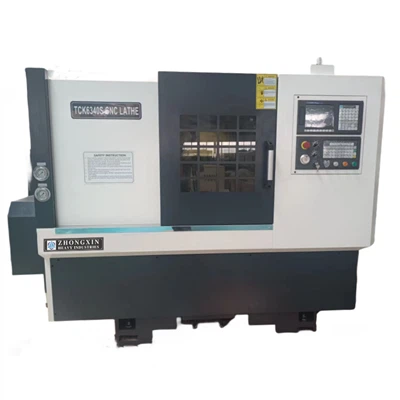
In the world of modern manufacturing, the New CNC Vertical Lathe has emerged as a revolutionary tool, offering unparalleled precision and efficiency. One of the most crucial features of this advanced machinery is the tool radius compensation function. As a trusted supplier of New CNC Vertical Lathes, I am excited to delve into the details of this function and explain its significance in the manufacturing process.


Understanding the Basics of Tool Radius Compensation
Before we explore the tool radius compensation function, it's essential to understand the concept of tool radius. In machining operations, cutting tools have a certain radius at their tip. When a programmer creates a part program, they typically define the path that the center of the tool should follow to create the desired shape. However, the actual cutting action occurs at the outer edge of the tool, which means that the path followed by the center of the tool needs to be adjusted to account for the tool's radius.
Tool radius compensation is a feature in CNC machines that automatically adjusts the tool path to compensate for the tool's radius. This adjustment ensures that the machined part meets the exact dimensions specified in the design. Without tool radius compensation, the machined part would be larger or smaller than the intended size, depending on whether the tool is cutting on the inside or outside of a contour.
How Tool Radius Compensation Works
The tool radius compensation function in a New CNC Vertical Lathe operates based on a set of commands and parameters that are programmed into the CNC control system. There are two main types of tool radius compensation: left compensation (G41) and right compensation (G42).
- Left Compensation (G41): When the G41 command is activated, the CNC control system shifts the tool path to the left side of the programmed path, relative to the direction of the tool's movement. This type of compensation is typically used when cutting on the outside of a contour.
- Right Compensation (G42): The G42 command shifts the tool path to the right side of the programmed path, relative to the direction of the tool's movement. Right compensation is used when cutting on the inside of a contour.
To activate tool radius compensation, the programmer must specify the compensation mode (G41 or G42), the tool number, and the tool radius value in the CNC program. The CNC control system then uses this information to adjust the tool path accordingly.
Here is a simple example of a CNC program that uses tool radius compensation:
N10 G90 G21 G40 G28 U0 W0 ; Initialize the machine
N20 T0101 ; Select tool 01 with offset 01
N30 S800 M03 ; Start the spindle at 800 RPM in clockwise direction
N40 G00 X50 Z2 ; Rapid move to the starting position
N50 G42 G01 X30 Z-10 F0.2 ; Start right tool radius compensation and feed to the cutting position
N60 G02 X20 Z-20 I-10 J0 ; Circular interpolation to cut a curve
N70 G40 G01 X50 Z2 ; Cancel tool radius compensation and rapid move back to the starting position
N80 M05 ; Stop the spindle
N90 M30 ; End the program
In this example, the G42 command in line N50 activates right tool radius compensation, and the G40 command in line N70 cancels the compensation.
Benefits of Tool Radius Compensation in a New CNC Vertical Lathe
The tool radius compensation function offers several significant benefits in a New CNC Vertical Lathe, making it an indispensable feature for modern machining operations.
- Improved Precision: By automatically adjusting the tool path to compensate for the tool's radius, tool radius compensation ensures that the machined part meets the exact dimensions specified in the design. This results in higher precision and better quality parts.
- Increased Efficiency: With tool radius compensation, programmers can create simpler and more efficient CNC programs. They no longer need to manually calculate and adjust the tool path to account for the tool's radius, which saves time and reduces the risk of programming errors.
- Extended Tool Life: Tool radius compensation helps to distribute the cutting forces more evenly across the tool's cutting edge, reducing wear and tear on the tool. This can extend the tool's life and reduce the frequency of tool changes, resulting in lower production costs.
- Flexibility in Tool Selection: With tool radius compensation, manufacturers have more flexibility in selecting cutting tools. They can use tools with different radii without having to modify the CNC program, as the compensation function will automatically adjust the tool path to ensure accurate machining.
Applications of Tool Radius Compensation in Different Industries
The tool radius compensation function in a New CNC Vertical Lathe is widely used in various industries, including automotive, aerospace, medical, and general manufacturing.
- Automotive Industry: In the automotive industry, New CNC Vertical Lathes are used to manufacture engine components, transmission parts, and other critical automotive parts. Tool radius compensation ensures that these parts are machined with high precision, meeting the strict quality standards of the automotive industry.
- Aerospace Industry: The aerospace industry demands the highest level of precision and quality in the manufacturing of aircraft components. Tool radius compensation in New CNC Vertical Lathes enables aerospace manufacturers to produce complex parts with tight tolerances, such as turbine blades and landing gear components.
- Medical Industry: In the medical industry, New CNC Vertical Lathes are used to manufacture medical devices and implants. Tool radius compensation helps to ensure the accuracy and consistency of these parts, which is crucial for patient safety and successful medical procedures.
- General Manufacturing: In general manufacturing, New CNC Vertical Lathes are used to produce a wide range of parts, from simple brackets to complex machinery components. Tool radius compensation allows manufacturers to achieve high precision and efficiency in their machining operations, regardless of the complexity of the part.
Choosing the Right New CNC Vertical Lathe with Tool Radius Compensation
As a supplier of New CNC Vertical Lathes, I understand the importance of choosing the right machine for your specific machining needs. When selecting a New CNC Vertical Lathe with tool radius compensation, there are several factors to consider.
- CNC Control System: The CNC control system is the brain of the New CNC Vertical Lathe. It should have a user-friendly interface and support advanced features such as tool radius compensation. Look for a machine with a reliable and proven CNC control system, such as Fanuc, Siemens, or Mitsubishi.
- Tooling Capability: The New CNC Vertical Lathe should have a sufficient number of tool stations and support a wide range of cutting tools. This will allow you to perform a variety of machining operations and use different tools with different radii.
- Accuracy and Repeatability: The accuracy and repeatability of the New CNC Vertical Lathe are crucial for achieving high-quality parts. Look for a machine with a high-precision ball screw drive system, linear guides, and a rigid machine structure to ensure stable and accurate machining.
- Technical Support and Training: When purchasing a New CNC Vertical Lathe, it's important to choose a supplier that offers comprehensive technical support and training. This will ensure that you can operate the machine effectively and make the most of its features, including tool radius compensation.
At our company, we offer a wide range of New CNC Lathe models with advanced tool radius compensation capabilities. Our Ck6132 CNC Lathe is a popular choice for small to medium-sized machining operations, while our Precision CNC Lathe is designed for high-precision and complex machining tasks.
Conclusion
The tool radius compensation function is a critical feature in a New CNC Vertical Lathe, offering improved precision, increased efficiency, extended tool life, and flexibility in tool selection. Whether you are in the automotive, aerospace, medical, or general manufacturing industry, tool radius compensation can help you achieve higher quality parts and lower production costs.
As a leading supplier of New CNC Vertical Lathes, we are committed to providing our customers with the latest technology and the best solutions for their machining needs. If you are interested in learning more about our New CNC Vertical Lathes or have any questions about tool radius compensation, please do not hesitate to contact us. We look forward to the opportunity to discuss your requirements and help you find the perfect machine for your business.
References
- "CNC Programming Handbook" by Peter Smid
- "Fundamentals of Modern Manufacturing: Materials, Processes, and Systems" by Mikell P. Groover
- "Machining Fundamentals" by John A. Schey