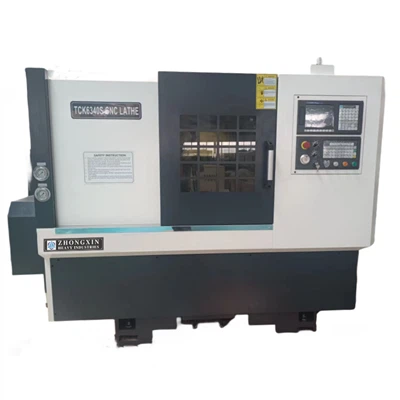
As a supplier of Precision CNC Lathes, I've witnessed firsthand the critical role that workholding methods play in the manufacturing process. Workholding is the technique of securing a workpiece in place during machining operations to ensure accuracy, precision, and safety. In this blog post, I'll delve into the various workholding methods used in Precision CNC Lathes, their advantages, and considerations for choosing the right one.
Chuck Workholding
One of the most common workholding methods in CNC lathes is the use of chucks. Chucks are devices that grip the workpiece securely and rotate it with the spindle. There are several types of chucks available, each with its own unique features and applications.
Three-Jaw Chuck
The three-jaw chuck is the most widely used chuck in CNC lathes. It consists of three jaws that move simultaneously to grip the workpiece. The jaws are typically self-centering, which means they automatically center the workpiece in the chuck. This makes it easy to set up and use, especially for round workpieces. The three-jaw chuck is suitable for a wide range of applications, from rough turning to finishing operations.
Four-Jaw Chuck
The four-jaw chuck is more versatile than the three-jaw chuck. It has four independent jaws that can be adjusted individually to grip irregularly shaped workpieces. This makes it ideal for machining square, rectangular, or hexagonal workpieces. However, setting up a four-jaw chuck requires more time and skill compared to a three-jaw chuck, as the jaws need to be adjusted carefully to center the workpiece accurately.


Collet Chuck
Collet chucks are used for holding small-diameter workpieces with high precision. They consist of a collet, which is a sleeve that grips the workpiece, and a collet nut that tightens the collet around the workpiece. Collet chucks provide excellent concentricity and gripping force, making them suitable for precision machining operations such as drilling, reaming, and threading.
Fixture Workholding
Fixtures are custom-made devices that are designed to hold a specific workpiece or a family of workpieces. They are used when the workpiece cannot be held securely by a chuck or when a high degree of accuracy and repeatability is required. Fixtures can be made from a variety of materials, such as steel, aluminum, or plastic, and can be designed to hold the workpiece in a specific orientation or position.
Vise Fixture
A vise fixture is a simple and versatile fixture that is used to hold workpieces between two jaws. Vise fixtures can be used for a wide range of applications, from small parts to large workpieces. They are available in different sizes and styles, and can be customized to fit the specific requirements of the workpiece.
Indexing Fixture
Indexing fixtures are used to rotate the workpiece to a specific angle or position during machining operations. They are commonly used for machining multiple features on a workpiece, such as holes, slots, or keyways. Indexing fixtures can be manual or automatic, and can be designed to index the workpiece in increments of degrees or fractions of degrees.
Angle Plate Fixture
An angle plate fixture is used to hold the workpiece at a specific angle relative to the spindle axis. Angle plate fixtures are commonly used for machining angled surfaces, such as bevels or chamfers. They can be made from a variety of materials, such as steel or aluminum, and can be designed to hold the workpiece securely in place.
Mandrel Workholding
Mandrels are used to hold workpieces that have a central hole or bore. They are typically used for machining the outer diameter of the workpiece, such as turning, grinding, or honing. Mandrels can be classified into two types: solid mandrels and expanding mandrels.
Solid Mandrel
A solid mandrel is a cylindrical rod that is inserted into the central hole of the workpiece. The workpiece is then clamped onto the mandrel using a chuck or a fixture. Solid mandrels are simple and inexpensive, but they can only be used for workpieces with a specific hole diameter.
Expanding Mandrel
An expanding mandrel is a type of mandrel that can be adjusted to fit different hole diameters. It consists of a tapered shaft and a series of expanding collets that are located on the shaft. When the shaft is tightened, the collets expand and grip the inner surface of the workpiece. Expanding mandrels provide a more secure and accurate grip compared to solid mandrels, and they can be used for a wider range of hole diameters.
Considerations for Choosing the Right Workholding Method
When choosing a workholding method for a Precision CNC Lathe, several factors need to be considered, including the type of workpiece, the machining operation, the required accuracy and precision, and the production volume. Here are some tips to help you choose the right workholding method:
- Workpiece Material and Shape: The material and shape of the workpiece will determine the type of workholding method that is most suitable. For example, round workpieces can be held securely by a chuck, while irregularly shaped workpieces may require a fixture or a custom-made workholding device.
- Machining Operation: The machining operation will also affect the choice of workholding method. For example, rough turning operations may require a more robust workholding method to withstand the high cutting forces, while finishing operations may require a more precise workholding method to ensure the accuracy and surface finish of the workpiece.
- Required Accuracy and Precision: The required accuracy and precision of the machining operation will determine the type of workholding method that is most suitable. For example, high-precision machining operations may require a collet chuck or an expanding mandrel to ensure the concentricity and accuracy of the workpiece.
- Production Volume: The production volume will also affect the choice of workholding method. For high-volume production, a more automated and efficient workholding method may be required to reduce setup time and increase productivity.
Conclusion
Workholding is a critical aspect of the machining process in a Precision CNC Lathe. Choosing the right workholding method can significantly improve the accuracy, precision, and productivity of the machining operation. As a supplier of Precision CNC Lathes, we offer a wide range of workholding solutions to meet the specific needs of our customers. Whether you need a chuck, a fixture, or a custom-made workholding device, we can provide you with the right solution.
If you're interested in learning more about our Precision CNC Lathes or our workholding solutions, please contact us for a consultation. We'd be happy to discuss your specific requirements and help you choose the right equipment for your manufacturing needs.
References
- Smith, J. (2018). CNC Machining Handbook. McGraw-Hill Education.
- Dooner, M. (2019). Workholding for Precision Machining. Society of Manufacturing Engineers.
- Groover, M. P. (2016). Fundamentals of Modern Manufacturing: Materials, Processes, and Systems. Wiley.
Additional Resources
If you are interested in our Precision CNC Lathes or have any questions about workholding methods, feel free to reach out to us. We are ready to assist you in finding the best solutions for your machining needs and look forward to discussing potential business opportunities with you.