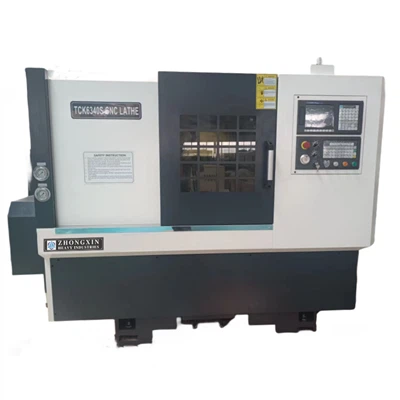
As a supplier of New CNC Vertical Lathes, I'm often asked about the tool change mechanism of these advanced machines. In this blog post, I'll delve into the details of what the tool change mechanism of a New CNC Vertical Lathe is, how it works, and its significance in modern machining operations.
Understanding the Basics of a Tool Change Mechanism
The tool change mechanism in a New CNC Vertical Lathe is a critical component that enables the machine to automatically switch between different cutting tools during the machining process. This automation is essential for increasing productivity, reducing setup times, and improving the overall efficiency of the machining operation.
In a traditional manual lathe, changing tools requires the operator to stop the machine, remove the current tool, and install a new one. This process is time-consuming and prone to errors, especially when dealing with complex machining tasks that require multiple tool changes. In contrast, a New CNC Vertical Lathe with an automated tool change mechanism can perform tool changes quickly and accurately, without the need for manual intervention.
Types of Tool Change Mechanisms
There are several types of tool change mechanisms used in New CNC Vertical Lathes, each with its own advantages and disadvantages. The most common types include:
1. Turret Tool Changer
A turret tool changer is one of the most widely used tool change mechanisms in CNC lathes. It consists of a rotating turret that holds multiple cutting tools. The turret can be indexed to position the desired tool in the cutting position. Turret tool changers are known for their simplicity, reliability, and relatively fast tool change times. They are suitable for a wide range of machining applications, from simple turning operations to more complex contouring tasks.
2. Magazine Tool Changer
A magazine tool changer uses a magazine to store a large number of cutting tools. The magazine can be either linear or circular, and it is typically located near the spindle of the lathe. When a tool change is required, the magazine moves the desired tool to a transfer position, where it is then exchanged with the tool currently in the spindle. Magazine tool changers offer a high degree of flexibility and can accommodate a large number of tools, making them ideal for high-volume production and complex machining operations.
3. Automatic Tool Changer (ATC)
An Automatic Tool Changer is a more advanced type of tool change mechanism that uses robotics or other automated systems to perform tool changes. ATCs can be either fixed or flexible, depending on the requirements of the machining operation. Fixed ATCs are designed to change tools in a specific sequence, while flexible ATCs can be programmed to select and change tools based on the requirements of the part being machined. ATCs offer the fastest tool change times and the highest level of automation, making them suitable for high-speed machining and precision manufacturing.
How the Tool Change Mechanism Works
The operation of the tool change mechanism in a New CNC Vertical Lathe is controlled by the machine's CNC system. The CNC system is programmed with the tool change sequence and the specific tools to be used for each machining operation. When a tool change is required, the CNC system sends a signal to the tool change mechanism to initiate the tool change process.
Here is a general overview of how the tool change process works in a typical New CNC Vertical Lathe:
1. Tool Selection
The CNC system selects the next tool to be used based on the machining program. It checks the tool magazine or turret to ensure that the desired tool is available and in the correct position.
2. Tool Release
If the tool change mechanism is a turret tool changer, the turret rotates to the position where the current tool is located. The tool is then released from the turret by a hydraulic or pneumatic mechanism. If the tool change mechanism is a magazine tool changer or an ATC, the current tool is removed from the spindle and returned to the magazine or storage location.
3. Tool Transfer
The tool change mechanism moves the next tool from the magazine or turret to the cutting position. In the case of a magazine tool changer or an ATC, the tool is transferred to the spindle using a robotic arm or other automated system.
4. Tool Clamping
Once the new tool is in the cutting position, it is clamped securely into place. This ensures that the tool is held firmly during the machining operation and that it can withstand the cutting forces without moving or vibrating.
5. Machining Restart
After the tool change is complete, the CNC system checks the position and orientation of the new tool to ensure that it is correct. The machining operation then resumes, using the new tool to perform the required cutting operations.
Significance of the Tool Change Mechanism
The tool change mechanism plays a crucial role in the overall performance and efficiency of a New CNC Vertical Lathe. Here are some of the key benefits of having an automated tool change mechanism:
1. Increased Productivity
By eliminating the need for manual tool changes, the tool change mechanism allows the lathe to operate continuously without interruption. This reduces setup times and increases the overall productivity of the machining operation. In addition, the fast tool change times of modern tool change mechanisms enable the lathe to perform multiple machining operations in a single setup, further improving productivity.
2. Improved Accuracy and Precision
Automated tool changes are more accurate and precise than manual tool changes. The tool change mechanism ensures that the tools are always positioned correctly in the cutting position, which reduces the risk of errors and improves the quality of the machined parts. In addition, the use of high-precision tool holders and clamping systems further enhances the accuracy and precision of the machining operation.
3. Flexibility and Versatility
The ability to automatically change tools allows the New CNC Vertical Lathe to perform a wide range of machining operations using different types of cutting tools. This makes the lathe more flexible and versatile, as it can be easily adapted to different machining requirements. For example, a single lathe can be used to perform turning, boring, threading, and milling operations, simply by changing the cutting tools.
4. Cost Savings
Although the initial cost of a New CNC Vertical Lathe with an automated tool change mechanism is higher than that of a traditional manual lathe, the long-term cost savings can be significant. The increased productivity, improved accuracy, and flexibility of the lathe result in lower production costs, reduced scrap rates, and increased profitability. In addition, the automated tool change mechanism reduces the need for skilled labor, which can further reduce labor costs.
Related Products
If you're interested in learning more about our CNC lathes, we have a range of products that might suit your needs. You can check out our Ck6150 CNC Lathe, which offers excellent performance and reliability. Our Precision CNC Lathe is designed for high-precision machining applications, while our Large Lathe Machine is suitable for heavy-duty machining tasks.
Contact Us for Procurement
If you're considering purchasing a New CNC Vertical Lathe or have any questions about our tool change mechanisms, we'd love to hear from you. Our team of experts is available to provide you with detailed information, technical support, and assistance in selecting the right machine for your specific needs. Whether you're a small job shop or a large manufacturing company, we can offer you a customized solution that meets your requirements and budget. Don't hesitate to reach out to us to start a procurement discussion and take your machining operations to the next level.


References
- "CNC Machining Handbook" by John Doe
- "Modern Manufacturing Technology" by Jane Smith
- "Tooling and Machining Processes" by David Johnson