



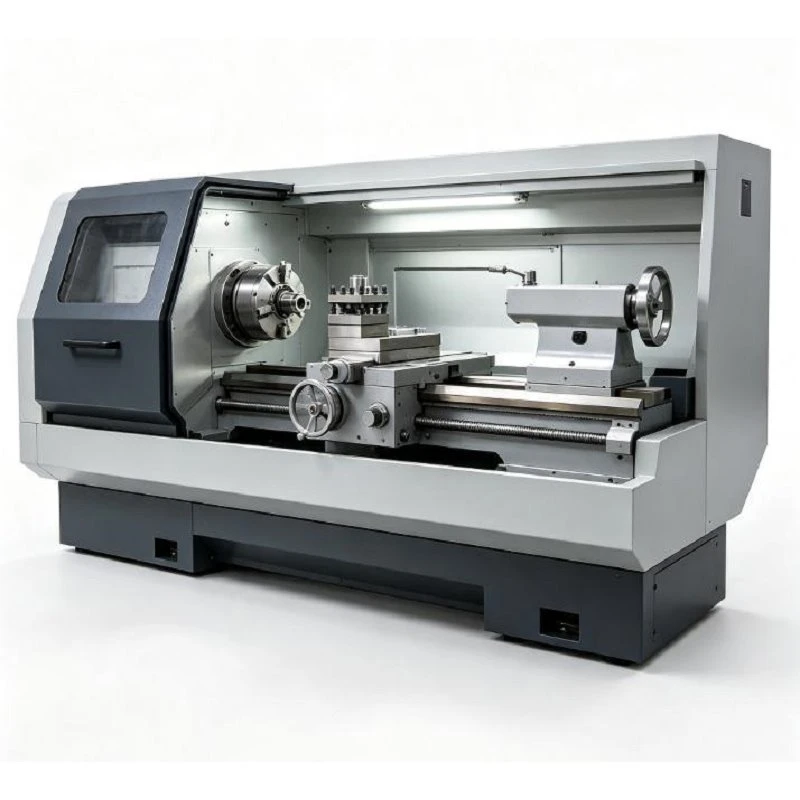
Twin Spindle Horizontal CNC Lathe
The Twin Spindle Horizontal CNC Lathe is engineered for precision turned components requiring operations on both ends.
The main spindle completes the first-side machining, after which the sub-spindle automatically takes over the workpiece to finish the opposite end. For suitable parts, this eliminates manual re-clamping, reversing, and secondary setups on separate machines-significantly reducing manual handling, cycle times, and setup error.
Technical Specifications
|
Specification |
Compact Model |
Mid-Size Model |
Heavy-Duty Model |
|
CNC Control System |
Fanuc / Siemens |
Fanuc / Siemens |
Fanuc / Siemens |
|
Main Spindle Chuck |
6 inch |
8 inch |
10 / 12 inch |
|
Sub-Spindle Chuck |
5 / 6 inch |
6 / 8 inch |
8 / 10 inch |
|
Main Spindle Bore |
52 mm |
65 mm |
75 / 90 mm |
|
Sub-Spindle Bore |
42 mm |
52 mm |
65 mm |
|
Main Spindle Speed |
5,000 rpm |
4,000 rpm |
3,000 rpm |
|
Sub-Spindle Speed |
5,000 rpm |
4,000 rpm |
3,000 rpm |
|
Main Spindle Motor |
7.5 / 11 kW |
11 / 15 kW |
15 / 22 kW |
|
Sub-Spindle Motor |
5.5 / 7.5 kW |
7.5 / 11 kW |
11 / 15 kW |
|
Max. Turning Diameter |
280 mm |
360 mm |
450 mm |
|
Max. Turning Length |
350 mm |
500 mm |
750 mm |
|
Turret Stations |
12 Stations |
12 / 16 Stations |
12 / 16 Stations |
|
Live Tooling / C-Axis |
Optional |
Optional |
Optional |
|
Y-Axis Travel |
Optional (±40 mm) |
Optional (±50 mm) |
Optional (±60 mm) |
|
Automation Interface |
Bar Feeder / Robot |
Bar Feeder / Robot |
Bar Feeder / Robot |
Key Benefits
Complete Machining in One Process: Machining of both ends within a single automated CNC cycle.
Reduced Manual Handling: Eliminates manual workpiece removal and repositioning between operations.
Improved Concentricity & Alignment: Controlled sub-spindle transfer preserves programmed geometric relationships between both ends.
Multitasking Capabilities: Combines turning, boring, threading, drilling, cross-hole milling, and tapping in one setup.
High-Efficiency Automation: Integrates seamlessly with bar feeders, gantry loaders, and robotic loading systems.
Typical Workpiece Applications
Stepped Shafts & Drive Pins: OD turning, shoulder grinding prep, and end-face threading in one pass.
Bushings, Sleeves & Rings: Concurrent ID boring, OD profiling, and back-side chamfering.
Hydraulic Fittings & Valve Bodies: Hex turning, multi-thread cutting, and cross-hole drilling with live tooling.
Flanges & Couplings: Heavy facing, bolt-hole circle drilling via C-axis, and back-side counterboring.
How Two-Side Machining Works
Raw Material Loading: Bar stock or discrete blanks are loaded into the main spindle manually or via bar feeder/robot.
Main Spindle Operations: Performs OD/ID turning, facing, step turning, grooving, external threading, drilling, and chamfering.
Synchronized Workpiece Transfer: The sub-spindle advances, grips the workpiece securely, and accepts transfer from the main spindle.
Sub-Spindle Operations: Executes back-side facing, OD/ID turning, internal threading, end-face drilling, and chamfering.
Part Discharge: Finished parts exit automatically via a parts catcher, conveyor, or robotic loader.
Core Machine Configuration & Components
Main Spindle: Handles heavy primary cutting. Important specs include spindle bore, chuck size, motor power, and maximum RPM.
Sub-Spindle: Synchronizes with the main spindle to hold and machine the opposite end.
Slant Bed Structure: Heavy-duty inclined bed ensures maximum rigidity, thermal stability, and effective chip/coolant evacuation.
Tooling Turret & Drives: Configurable with standard turn/bore stations or driven (live) tool stations for milling and tapping.
CNC Control Systems: Pre-configured with industry-standard controls.
Machining Capabilities
Turning & Threading: OD/ID turning, contouring, facing, grooving, parting, and single/multi-start threading.
Drilling & Boring: High-precision center drilling, deep-hole drilling, ID boring, and chamfering.
Milling & Tapping (With Live Tooling & C-Axis): Radial/end-face drilling, off-center cross-hole tapping, slotting, keyway milling, and complex surface interpolation.
Off-Center Operations (With Y-Axis): Precise multi-axis milling and off-center drilling without re-setup.
Quality Assurance
Structural Stability: Fine-grain cast iron bed aged to relieve stress, ensuring long-term thermal and mechanical accuracy under heavy cuts.
Transfer Repeatability: Micro-switches and dynamic torque detection verify precise workpiece seating during sub-spindle pickup.
Factory Calibration: 100% evaluated using Renishaw laser interferometers for linear positioning and ball-bar tests for circularity prior to shipment.
FAQ
Hot Tags: twin spindle horizontal cnc lathe, China twin spindle horizontal cnc lathe manufacturers, suppliers, factory, cnc lathe machine, high speed lathe machine, lathe machine angularity, lathe machine belt, lathe machine compound slide, lathe machine table
You Might Also Like

Send Inquiry