



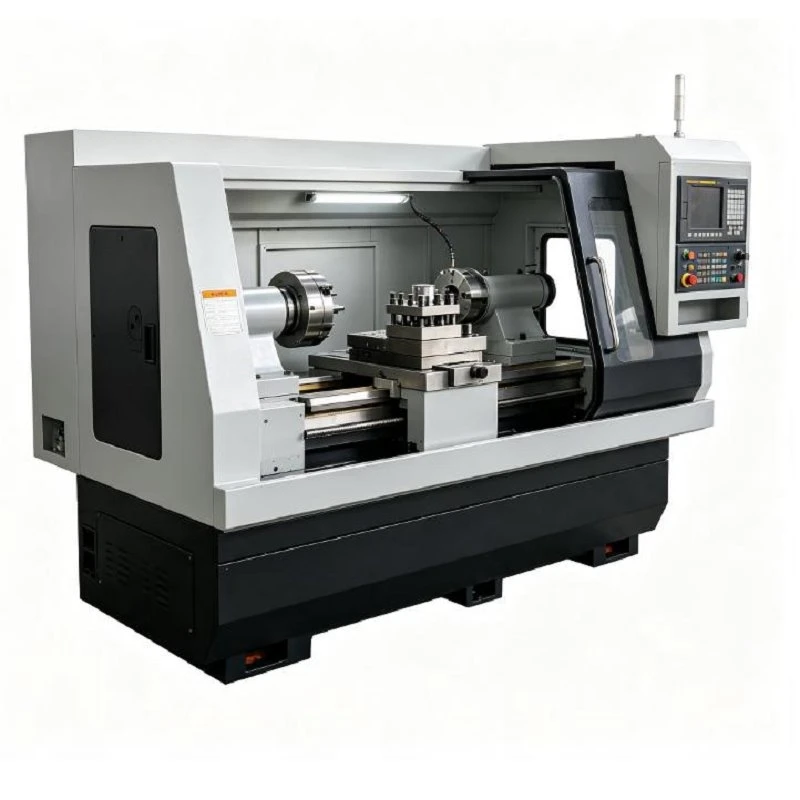
Twin Spindle Automated CNC Lathe
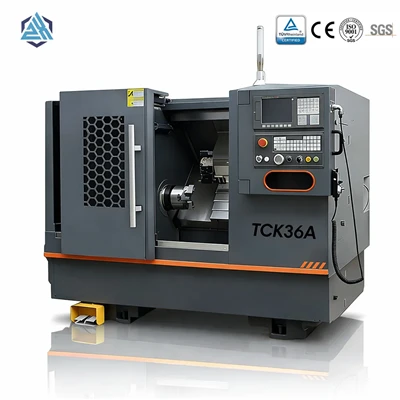
The Twin Spindle Automated CNC Lathe is engineered for complex turned components requiring machining on both ends within a single, continuous process.
By integrating a main spindle and a sub-spindle, the machine performs first-stage operations on the main spindle, then automatically transfers the workpiece to the sub-spindle for back-side machining. This seamless handoff eliminates secondary setups, reduces manual re-clamping, and prevents alignment errors.
Technical Specifications
|
Specification |
Standard Configuration Range |
|
Machine Type |
Twin Spindle Automated CNC Lathe |
|
Max Turning Diameter / Length |
Ø250 mm – Ø400 mm / 300 mm – 600 mm |
|
Main Spindle Speed / Power |
4,000 – 6,000 RPM / 11 kW – 15 kW |
|
Sub-Spindle Speed / Power |
4,000 – 6,000 RPM / 7.5 kW – 11 kW |
|
Bar Capacity / Spindle Bore |
Ø45 mm – Ø65 mm |
|
Workholding Types |
Hydraulic Chuck / Pneumatic Chuck / Collet System |
|
Turret Capacity / Live Tooling |
12-Station Servo Turret / BMT or VDI Live Tools |
|
Y-Axis / Travel (X/Z) |
Standard/Optional |
|
Automation Integration |
Bar Feeder / Gantry Loader / Robotic Loader / Parts Catcher |
|
Chip Removal System |
Automatic Chain-type Chip Conveyor |
Common Industry Applications
Automotive: Shafts, hubs, bushings, sleeves, couplings, and transmission components.
Hydraulics & Pneumatics: Valve bodies, fittings, sleeves, pins, and fluid connectors.
Industrial Machinery: Flanges, couplings, precision pins, and custom stepped shafts.
Fluid Control: Precision cylindrical valve bodies, connectors, and threaded fittings.
Spindle, Chuck, Turret and Tooling Configuration
Main & Sub-Spindle System: Engineered for high thermal stability and synchronized speed control during dynamic workpiece transfer.
Workholding Options: Available with hydraulic or pneumatic chucks, collet chucks, soft/hard jaws, or custom-engineered fixtures to match delicate or heavy-duty gripping requirements.
Index Turret & Live Tooling: High-speed indexing turrets accommodate turning tools, boring bars, and live tooling (cross-drilling, end-face milling, tapping, and slotting) to perform complete secondary operations on one machine.
How the Main Spindle and Sub-Spindle Work
Workpiece Loading: Raw bar stock or individual blanks are loaded into the main spindle via an automated bar feeder, gantry loader, or articulated robot.
Main Spindle Machining: Performs front-end operations, including facing, outer diameter turning, inner diameter boring, drilling, grooving, and threading.
Sub-Spindle Takeover: The sub-spindle synchronizes with the main spindle, advances into position, grips the workpiece securely, and completes the automated handoff.
Opposite-Side Machining: The sub-spindle presents the unmachined end to the tool turret for back-side facing, secondary OD/ID turning, grooving, threading, and finishing.
Part Unloading: The finished component is removed automatically via a parts catcher or robotic end-effector onto an outgoing conveyor.
Single Spindle vs. Twin Spindle CNC Lathe
|
Process Requirement |
Single Spindle CNC Lathe |
Twin Spindle Automated CNC Lathe |
|
Two-Sided Machining |
Requires manual setup / 2nd machine |
Fully automated in one cycle |
|
Concentricity Control |
Operator dependent |
Consistently tight (±0.008 mm) |
|
Manual Re-clamping |
Required between operations |
Eliminated via automatic transfer |
|
Production Efficiency |
Standard turnaround |
Up to 40% faster cycle time |
|
Automation Integration |
Standard options |
Full turnkey lights-out integration |
Machine Configuration and Customization
We offer flexible tailoring to integrate seamless machinery into your existing workshop floor:
Spindle & Power Options: Custom spindle bores and torque curves based on material removal rates.
Turret Configurations: Static-only, live tooling, or twin turrets for simultaneous cutting.
CNC Control Systems: Pre-configured to standard shop interfaces (FANUC, Siemens, Mitsubishi, Syntec).
Automation Systems: Tailored interface protocols for robotic automation, probing systems, and tool breakage detectors.
FAQ
Hot Tags: twin spindle automated cnc lathe, China twin spindle automated cnc lathe manufacturers, suppliers, factory, lathe machine boring tools, lathe machine cutting tools, lathe machine drilling tools, lathe machine facing tools, lathe machine surface finish, precision lathe machine
You Might Also Like

Send Inquiry