



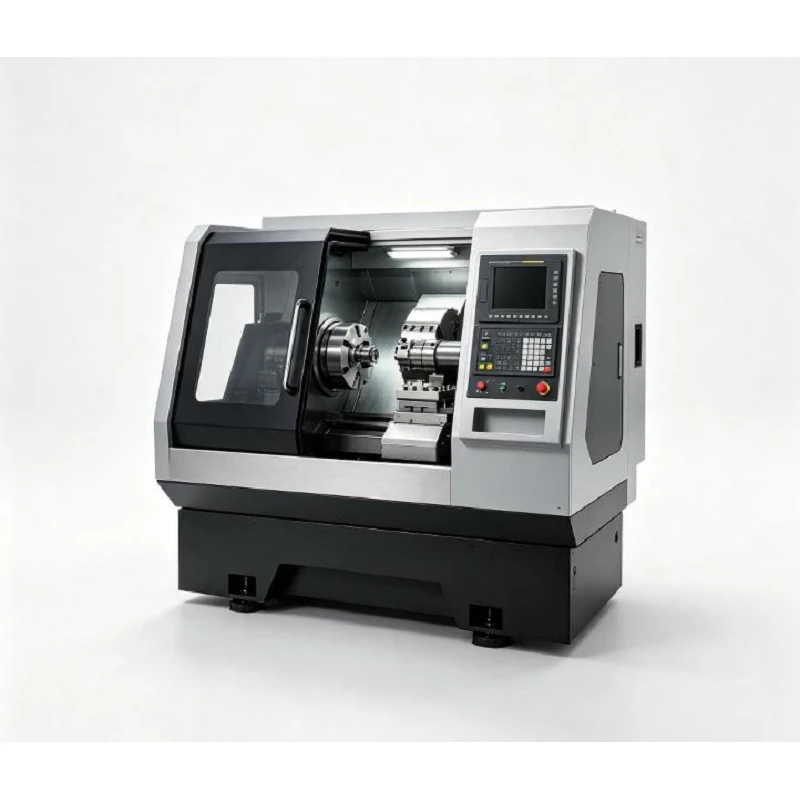
Twin Spindle Turning Center
The Twin Spindle Turning Center is designed for turned components requiring machining on both ends. The main spindle performs the first machining operations, and the sub-spindle takes over the workpiece inside the machine for second-side machining. This eliminates separate manual setups, reduces cycle time by up to 40%, and keeps both operations within a single CNC process. It is suitable for shafts, bushings, sleeves, hydraulic fittings, hubs, couplings, flanges, and other precision components requiring multi-process machining.
Technical Specifications
|
Item |
Reference Specification |
|
Machine Type |
Twin Spindle CNC Turning Center |
|
CNC Control |
FANUC / Siemens / Mitsubishi, optional |
|
Spindle Configuration |
Main Spindle + Sub-Spindle |
|
Chuck Size |
6" / 8" / 10" |
|
Main Spindle Motor |
Approx. 11–18.5 kW |
|
Sub-Spindle Motor |
Approx. 7.5–15 kW |
|
Main Spindle Speed |
Up to 4,000–6,000 rpm |
|
Sub-Spindle Speed |
Up to 4,000–6,000 rpm |
|
Main Spindle Bore |
Approx. Ø52–86 mm |
|
Main Spindle Bar Capacity |
Approx. Ø42–65 mm |
|
Sub-Spindle Bore |
Approx. Ø42–62 mm |
|
Max. Turning Diameter |
Approx. Ø200–350 mm |
|
Max. Turning Length |
Approx. 200–600 mm |
|
X-Axis Travel |
Approx. 180–250 mm |
|
Z-Axis Travel |
Approx. 300–700 mm |
|
Sub-Spindle Z-Axis Travel |
Approx. 300–700 mm |
|
Turret |
8 / 10 / 12 / 16 stations |
|
Live Tooling |
Optional |
|
C-Axis |
Optional / configuration dependent |
|
Y-Axis |
Optional |
|
Live Tool Speed |
Up to approx. 4,000–6,000 rpm |
|
Spindle Nose |
A2-5 / A2-6 / A2-8, configuration dependent |
|
Hydraulic Chuck |
Standard / optional according to configuration |
|
Bar Feeder |
Optional |
|
Parts Catcher |
Optional |
|
Chip Conveyor |
Optional |
|
Coolant System |
Standard |
|
Automatic Tool Measurement |
Optional |
|
Workpiece Transfer |
CNC-controlled |
Application Industries
Automotive & Transportation: High-volume drive components, sensor bodies, and hydraulic fittings.
Hydraulics & Fluid Power: Precision valve bodies, fluid adapters, and manifold sleeves.
Industrial Machinery: Precision spacers, rollers, drive pins, and motor shafting.
Aerospace & Medical: High-tolerance connectors, cylindrical enclosures, and titanium/stainless fittings.
Contract Precision Machine Shops: Job shops seeking lower labor overhead and versatile two-sided production capacity.
Why Choose a Twin Spindle Turning Center?
|
Operational Stage |
Conventional CNC Lathe |
Twin Spindle Turning Center |
|
First-Side Machining |
Completed on Main Spindle |
Completed on Main Spindle |
|
Part Transfer |
Manual operator unloading |
Automated internal sub-spindle transfer |
|
Second-Side Setup |
Separate machine / manual re-clamping |
Sub-spindle holds part in same cycle |
|
Alignment Accuracy |
Operator-dependent re-clamping errors |
Precision spindle-synchronized handover |
|
Production Handling |
High manual intervention |
Minimal operator intervention / High ROI |
How Twin Spindle Machining Works
Main Spindle Clamping: Raw bar stock or blank is secured in the main spindle.
First-Side Machining: The servo turret performs primary turning, facing, boring, grooving, or threading.
Part Transfer: The sub-spindle moves axially to sync with main spindle rotation and clamps the workpiece.
Spindle Handover: Main spindle unclamps or cutoff occurs, handing the workpiece smoothly to the sub-spindle.
Second-Side Machining: The sub-spindle holds the part while remaining secondary features are machined.
Part Unloading: The completed part is safely ejected to an integrated parts catcher or automation arm.
Turret, C-Axis, Y-Axis, and Live Tooling Options
High-Speed Servo Turret: Rapid index times reduce non-cutting cycle time.
C-Axis Contouring: Full 360° spindle indexing enables precise angular positioning for pitch-circle hole drilling, slotting, and keyway milling.
Driven Live Tooling: High-torque driven tool stations turn your lathe into a turn-mill center, completing off-center secondary operations in the same setup.
Y-Axis Capability: Provides perpendicular linear movement relative to the spindle center, allowing off-axis cross-drilling, multi-flute milling, and complex keyway features.
Typical Machined Workpieces
Shafts & Pins: Stepped drive shafts, splined pins, and guide rods requiring two-sided alignment.
Bushings & Sleeves: Precision sleeves needing concentric ID boring and OD turning on both ends.
Hydraulic & Pneumatic Fittings: Valve spools, adapters, hose connectors, and fluid blocks with multi-step threads.
Hubs & Couplings: Rotary couplings and power transmission flanges.
Connectors & Housings: Cylindrical electrical housings with complex face/radial holes.
Configuration Guide
Tailor options to match specific production bottlenecks:
Larger Spindle Bore: For continuous processing of oversized bar stock.
C-Axis + Live Tooling: Solves secondary cross-drilling and face-milling requirements.
Y-Axis Motion: Essential for complex off-center features and precise flat milling.
Automatic Bar Feeder: Enables unattended 24/7 continuous bar stock feeding.
Parts Catcher & Unloader: Safely transfers finished components out of the enclosure without scratching.
Gantry / Robotic Arm Loading: Ideal for heavy individual forged blanks where bar stock feeding is not applicable.
Pre-Shipment Testing Protocol
Every machine undergoes strict quality verification prior to dispatch:
Laser interferometer positioning and repeatability accuracy checks
Spindle dynamic balance testing and full-rpm run-in testing
Automated spindle transfer sequence and hydraulic pressure stability checks
Full functional testing of CNC controls, safety interlocks, and coolant delivery
Trial Machining: Optional test cuts performed on customer part drawings prior to shipment upon request.
FAQ
Hot Tags: twin spindle turning center, China twin spindle turning center manufacturers, suppliers, factory, horizontal lathe machine, lathe machine headstock, lathe machine spare parts, lathe machine tool post, lathe machine workpiece, semi automatic lathe machine
Next
No InformationYou Might Also Like


Send Inquiry