



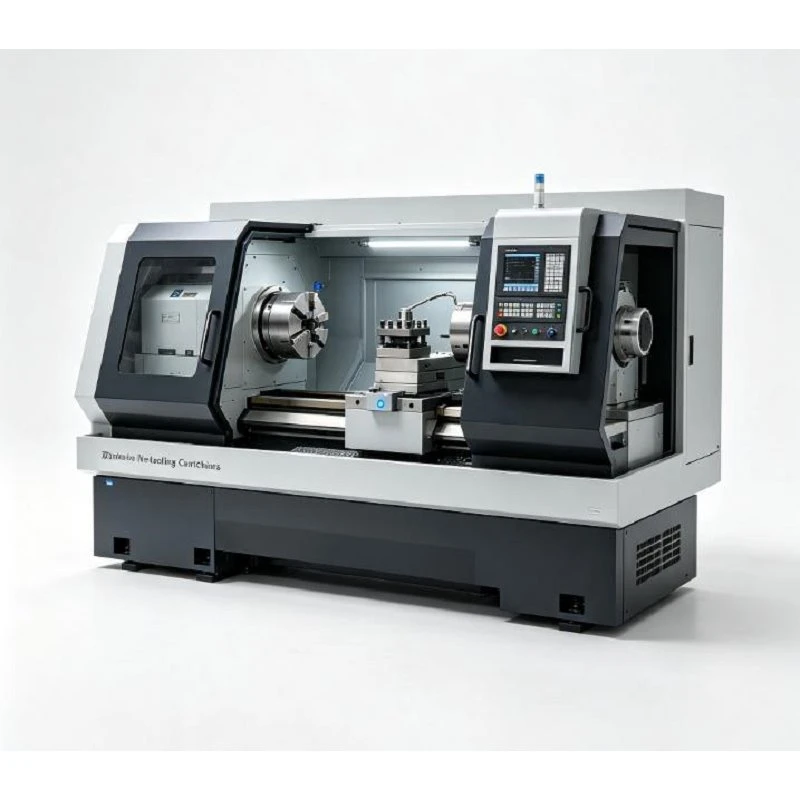
Twin Spindle Live Tooling Lathe
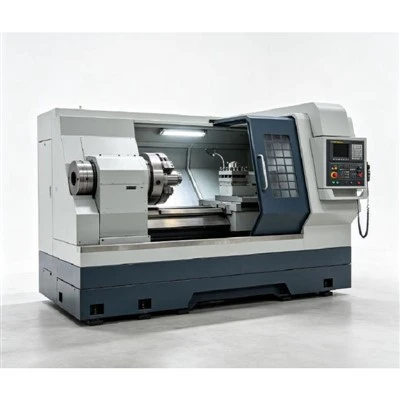
The Twin Spindle Live Tooling Lathe combines a main spindle, sub-spindle, CNC turret, and driven tooling for turning and secondary machining operations.
The main spindle handles the first machining stage. The sub-spindle takes over the workpiece for rear-side machining, while live tooling performs drilling, tapping, slotting, and milling. This setup enables complete component processing in a single production route, eliminating manual re-chucking and extra machine transfers.
Technical Specifications
|
Specification |
Standard Parameter Range |
|
Machine Type |
Twin Spindle Live Tooling CNC Lathe |
|
CNC Control |
FANUC / Siemens / Mitsubishi |
|
Main / Sub-Spindle Speed |
Up to 4,000–6,000 rpm |
|
Main / Sub-Spindle Motor |
11 / 15 kW (Model Dependent) |
|
Max. Turning Diameter |
320 mm |
|
Max. Turning Length |
500 mm |
|
Max. Bar Capacity |
51 mm / 65 mm |
|
Turret Type & Tool Stations |
12-Station Servo Turret (All Live Tool Capable) |
|
Live Tool Speed / Motor |
4,000–6,000 rpm / 3.7 kW |
|
X / Z / Y Axis Travel |
X: 200 mm | Z: 550 mm | Y: ±40 mm |
|
C-Axis Resolution |
0.001° (Main & Sub-Spindle) |
|
Rapid Traverse Rates |
24 / 30 m/min |
|
Automation Options |
Bar Feeder Interface, Parts Catcher, Chip Conveyor |
Why Use a Twin Spindle Live Tooling Lathe?
Single-Setup Production: Complete turning, drilling, tapping, and milling in one unified production route.
Elimination of Human Error: Automated transfer removes manual re-clamping variation and improves batch consistency.
Floor Space & Labor Efficiency: One machine replaces separate turning and milling stations, lowering labor and energy consumption per unit.
Seamless Automation Integration: Standardized interfaces make pairing with bar feeders, gantry cranes, or articulated robots quick and straightforward.
Suitable Parts and Application Industries
Automotive & Drive Systems: Transmission shafts, drive pins, sensor housings, fuel rail connectors, and splined hubs.
Fluid Power & Hydraulics: Valve spools, hydraulic fittings, manifold adapters, pneumatic sleeves, and connectors.
Medical & Precision Technology: Bone screws, instrument bodies, connectors, and specialized fittings requiring high surface finish.
General Industrial Machinery: Stepped shafts, custom bushings, flanged couplings, and motor shafts.
Machine Configuration
The machine configuration is selected according to component geometry and production goals:
Spindle System: Main spindle for primary turning, synchronized sub-spindle for rear-side operations, full C-axis positioning, and hydraulic chuck or collet workholding.
Turret & Tooling: Multi-station CNC turret supporting static turning tools and live tooling positions. Optional Y-axis for off-center milling applications.
CNC & Automation: FANUC, Siemens, or Mitsubishi CNC controls; optional bar feeder, parts catcher, chip conveyor, gantry loader, or robotic loading interface.
Twin Spindle System
The main and sub-spindles divide the machining process between both ends of the workpiece:
Main Spindle: Performs initial OD turning, ID boring, facing, grooving, and threading.
Sub-Spindle: Grips the workpiece during programmed cutoff to execute rear-side turning, facing, boring, and secondary milling.
Workpiece Transfer: Fully automated via C-axis phase synchronization, ensuring precision alignment between front and rear features.
Machine Comparison: Standard CNC Lathe vs. Twin Spindle System
|
Production Feature |
Standard CNC Lathe |
Twin Spindle Live Tooling Lathe |
|
Front Turning / Boring |
Fully Capable |
Fully Capable |
|
Rear-Side Machining |
Requires 2nd Setup / Operator |
Automated Sub-Spindle Transfer |
|
Drilling / Milling / Tapping |
Requires Secondary Milling Unit |
Integrated Live Tooling |
|
Off-Center Features |
N/A |
Available via Y-Axis Option |
|
Bar-Fed Continuous Run |
Semi-Automated |
Fully Automated Front-to-Back |
Engineering Input Requirements
To evaluate your process and provide a formal machine recommendation, please supply:
Part 2D/3D engineering drawings (STEP, IGES, PDF)
Raw material grade and blank stock dimensions
Annual volume targets and target cycle time
Critical tolerances and surface finish specs
FAQ
Hot Tags: twin spindle live tooling lathe, China twin spindle live tooling lathe manufacturers, suppliers, factory, lathe machine chuck, lathe machine clutch, lathe machine repair, lathe machine tapping tools, lathe machine tool post, plastic lathe machine
You Might Also Like

Send Inquiry