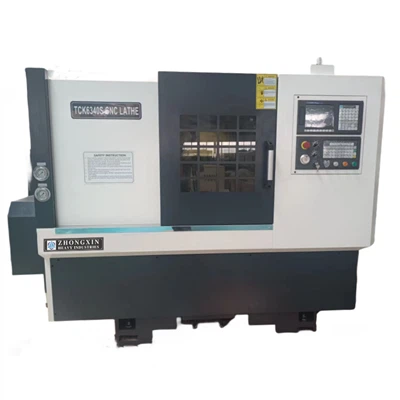
Performing taper turning on a manual lathe is a fundamental skill that can significantly expand the capabilities of your machining projects. As a manual lathe supplier, I've witnessed firsthand the transformative power of mastering this technique. In this blog post, I'll guide you through the process of taper turning on a manual lathe, from understanding the basics to executing precise cuts.
Understanding Taper Turning
Taper turning involves machining a workpiece so that the diameter changes uniformly along its length. This creates a conical shape, which is useful in a variety of applications, such as creating mating parts, adjusting fits, and adding aesthetic appeal to your work. There are several methods to achieve taper turning on a manual lathe, each with its own advantages and limitations.
Methods of Taper Turning
1. Using the Compound Rest
The compound rest method is one of the most common and straightforward ways to turn a taper on a manual lathe. Here's how it works:
- Calculate the Taper Angle: First, you need to determine the taper angle. This can be calculated using the formula: $\theta=\arctan(\frac{D - d}{2L})$, where $D$ is the large diameter, $d$ is the small diameter, and $L$ is the length of the taper.
- Set the Compound Rest: Loosen the compound rest lock and swivel it to the calculated angle. Make sure to take into account the direction of the taper (right - hand or left - hand).
- Make the Cut: With the workpiece properly secured in the chuck, engage the compound rest feed and slowly turn the taper. This method is suitable for short tapers and provides good control.
2. Using the Tailstock Setover
The tailstock setover method is used for long tapers. Here are the steps:
- Calculate the Setover: The setover ($S$) can be calculated using the formula: $S = \frac{(D - d)L}{2l}$, where $D$ and $d$ are the large and small diameters respectively, $L$ is the length of the workpiece, and $l$ is the length of the taper.
- Adjust the Tailstock: Loosen the tailstock lock and move the tailstock body the calculated setover amount, either towards or away from the operator depending on the taper direction.
- Turn the Taper: Once the tailstock is set, start turning the workpiece. Note that this method may not be as accurate for short tapers.
3. Using a Taper Attachment
A taper attachment is a specialized accessory that can be used to turn tapers with high precision. Here's how to use it:
- Install the Taper Attachment: Mount the taper attachment to the lathe bed and connect it to the cross - slide.
- Set the Taper Angle: Adjust the taper attachment to the desired taper angle.
- Engage the Taper Attachment: When turning, engage the taper attachment to guide the cross - slide, allowing for automatic taper turning. This method is ideal for producing consistent and accurate tapers over long lengths.
Preparing for Taper Turning
Before you start taper turning, it's essential to prepare your manual lathe and workpiece properly.
1. Selecting the Right Manual Lathe
As a manual lathe supplier, I can recommend different types of lathes for taper turning. For small - scale projects, a Mini Lathe Machine may be sufficient. It's compact, easy to operate, and can handle light - duty taper turning. If you need high precision and are working on more complex projects, a High Precision Manual Lathe is a better choice.
2. Choosing the Right Tooling
Selecting the appropriate cutting tool is crucial for successful taper turning. A sharp, well - ground tool will ensure clean cuts and accurate dimensions. Carbide inserts are a popular choice due to their durability and ability to maintain a sharp edge.
3. Securing the Workpiece
Properly securing the workpiece in the chuck or between centers is essential. Make sure the workpiece is centered and tightened to prevent it from moving during the turning process.
Executing the Taper Turn
Once you've prepared your lathe and workpiece, it's time to start the taper turning process.
1. Roughing Cuts
Begin with roughing cuts to remove the majority of the excess material. Use a larger depth of cut and a higher feed rate to quickly shape the workpiece. This will help reduce the time required for finishing cuts.
2. Finishing Cuts
After the roughing cuts, make finishing cuts with a smaller depth of cut and a slower feed rate. This will ensure a smooth surface finish and precise dimensions.
3. Measuring the Taper
Regularly measure the taper using tools such as a taper gauge or a micrometer. Make adjustments as needed to achieve the desired taper angle and dimensions.
Troubleshooting Common Issues
During taper turning, you may encounter some common issues. Here are some solutions:


- Inaccurate Taper Angle: Check your calculations and the setup of your lathe. Make sure the compound rest is properly set, or the tailstock is correctly adjusted.
- Poor Surface Finish: This could be due to a dull cutting tool or incorrect cutting parameters. Replace the tool if necessary and adjust the feed rate and depth of cut.
- Chatter: Chatter can be caused by excessive vibration. Check the workpiece and tooling for proper clamping, and adjust the cutting parameters to reduce vibration.
Conclusion
Taper turning on a manual lathe is a valuable skill that can enhance your machining capabilities. By understanding the different methods, properly preparing your lathe and workpiece, and executing the taper turn with care, you can achieve precise and high - quality tapers.
As a manual lathe supplier, we offer a wide range of Manual Lathe For Sale to meet your specific needs. Whether you're a hobbyist or a professional machinist, our manual lathes are designed to provide reliable performance and precision.
If you're interested in purchasing a manual lathe or have any questions about taper turning, feel free to reach out to us. We're here to assist you in your machining journey and help you choose the right equipment for your projects.
References
- "Machinery's Handbook" by Industrial Press Inc.
- "Modern Machine Shop Magazine" - various articles on lathe operations.