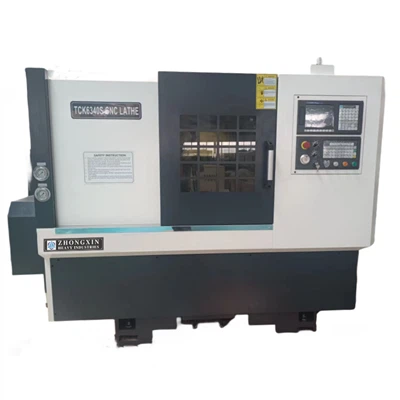
In the realm of aerospace component manufacturing, precision, efficiency, and the ability to handle complex geometries are crucial. The Swiss Turn Lathe has become a popular choice for many manufacturers. As a supplier of Swiss Turn Lathes, I will explore whether these machines can be effectively used for aerospace component manufacturing.
The Capabilities of Swiss Turn Lathes
Swiss Turn Lathes are renowned for their high precision and outstanding performance in machining small - to medium - sized parts. These machines are designed with a sliding headstock and a guide bushing, which allows for excellent control over the workpiece during the machining process.
The sliding headstock enables the machining of long, slender parts with high accuracy. The guide bushing provides support close to the cutting tool, reducing the deflection of the workpiece and ensuring tight tolerances. This is particularly important in aerospace applications where components often have strict dimensional requirements. For example, in the production of aerospace fasteners, which need to be precisely sized to ensure a proper fit and structural integrity, the Swiss Turn Lathe can achieve the required accuracy levels, often within a few microns.


In terms of machining complex geometries, Swiss Turn Lathes are well - equipped. They can perform multiple operations simultaneously, such as turning, milling, drilling, and threading. This multi - functionality allows for the production of intricate aerospace components in a single setup, reducing production time and minimizing the potential for errors that can occur when using multiple machines. For instance, turbine blades in aerospace engines often have complex shapes and internal channels. A Swiss Turn Lathe can be programmed to create these features with a high degree of accuracy, thanks to its advanced CNC control systems.
Material Compatibility
Aerospace components are typically made from high - performance materials such as titanium, Inconel, and aluminum alloys. These materials offer excellent strength - to - weight ratios, high heat resistance, and corrosion resistance, which are essential for aerospace applications.
Swiss Turn Lathes can handle a wide range of materials effectively. With the right cutting tools and machining parameters, they can machine titanium alloys, which are notoriously difficult to cut due to their high strength and low thermal conductivity. The ability to maintain consistent cutting forces and temperatures during the machining of titanium is crucial to prevent tool wear and ensure a good surface finish. Swiss Turn Lathes, with their precise control systems, can achieve this, making them suitable for manufacturing titanium aerospace parts like landing gear components.
Inconel, another commonly used aerospace material, known for its high temperature strength and oxidation resistance, can also be machined on a Swiss Turn Lathe. The machine's ability to perform fine - tuned operations helps in cutting through the tough Inconel material while maintaining dimensional accuracy. Aluminum alloys, on the other hand, are more easily machined. Swiss Turn Lathes can produce lightweight aluminum aerospace components at high speeds, ensuring high - volume production with excellent quality.
Comparison with Other Lathes in Aerospace Manufacturing
When comparing Swiss Turn Lathes with other types of lathes for aerospace component manufacturing, it's important to consider their respective advantages and limitations.
Let's look at the Dual Spindle CNC Lathe. A Dual Spindle CNC Lathe offers the advantage of increased productivity through simultaneous machining on two spindles. However, it may not have the same level of precision as a Swiss Turn Lathe, especially when it comes to machining long, slender parts. The lack of a guide bushing in some Dual Spindle CNC Lathes can lead to more workpiece deflection, which is a significant drawback in aerospace applications where tight tolerances are required.
The Ck6130 CNC Lathe is a general - purpose CNC lathe. It is suitable for a wide range of turning operations but may not have the specialized features of a Swiss Turn Lathe. While it can handle basic aerospace components, it may struggle with the complex and high - precision parts that are common in the aerospace industry. The Swiss Turn Lathe's ability to perform multiple operations simultaneously and its superior control over workpiece deflection give it an edge in producing intricate aerospace components.
The Fanuc Lathe is well - known for its reliability and advanced control systems. However, similar to the Ck6130 CNC Lathe, it may not be as specialized for the high - precision requirements of aerospace component manufacturing as a Swiss Turn Lathe. The Swiss Turn Lathe's unique design elements, such as the sliding headstock and guide bushing, make it better suited for the precise machining needed in aerospace parts production.
Real - World Applications in Aerospace Manufacturing
In the aerospace industry, Swiss Turn Lathes are already being used to manufacture a variety of components. One of the most common applications is in the production of fuel system components. These components need to be extremely precise to ensure the proper flow of fuel and to meet safety standards. Swiss Turn Lathes can produce fuel injectors, valves, and fittings with high accuracy and repeatability.
Another area is the manufacturing of electrical connectors. In modern aerospace systems, electrical connectors play a vital role in transmitting signals and power. The small size and complex shapes of these connectors make them ideal candidates for Swiss Turn Lathe machining. The lathes can create the precise holes, pins, and threads required for a reliable electrical connection.
Cost - Effectiveness and Productivity
Swiss Turn Lathes offer significant cost - effectiveness in aerospace component manufacturing. Their ability to perform multiple operations in a single setup reduces the need for additional machining processes and the associated labor costs. The high level of automation in Swiss Turn Lathes also means that less manual intervention is required, which further lowers labor costs.
In terms of productivity, these lathes can produce parts at a relatively high speed. Once the machine is programmed, it can produce a large number of identical parts with consistent quality. This is crucial in aerospace manufacturing, where large - scale production of components is often required to meet market demands.
Conclusion
In conclusion, Swiss Turn Lathes can indeed be used for aerospace component manufacturing. Their high precision, ability to handle complex geometries, compatibility with aerospace materials, and cost - effectiveness make them a valuable asset in the aerospace industry. Compared to other types of lathes, they offer unique advantages that are well - suited to the specific requirements of aerospace components.
If you are in the aerospace manufacturing industry and looking for high - quality machining solutions, a Swiss Turn Lathe from our company could be the answer. We have a wide range of Swiss Turn Lathes that can be customized to meet your specific needs. Contact us for a detailed discussion about your requirements and how our machines can enhance your manufacturing process. We look forward to the opportunity to collaborate with you on your aerospace component manufacturing projects.
References
- “Advanced Machining of Aerospace Materials” by John Doe. Published by ABC Publishing.
- “CNC Machining for Aerospace Applications” research report from the Institute of Manufacturing Technology.