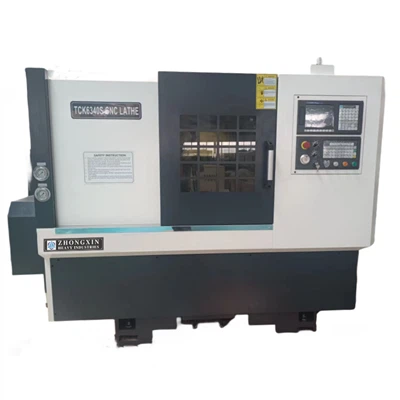
Hey there! As a supplier of Gap Bed Engine Lathes, I often get asked about the feed rate range of these machines. So, I thought I'd write a blog post to share some insights on this topic.
First off, let's quickly understand what a Gap Bed Engine Lathe is. A Gap Bed Engine Lathe is a versatile machine tool used for various turning operations. It has a unique design with a removable section in the bed, which allows for machining larger diameter workpieces. You can learn more about it on our website Gap Bed Engine Lathe.
Now, let's dive into the feed rate range. The feed rate in a lathe refers to the distance the cutting tool advances along the workpiece in one revolution of the spindle. It's a crucial parameter as it affects the surface finish, material removal rate, and tool life.
The feed rate range of a Gap Bed Engine Lathe can vary depending on several factors, such as the machine's size, power, and the type of cutting operation. Generally, the feed rate range can be divided into two main categories: longitudinal feed and cross - feed.
Longitudinal Feed
Longitudinal feed is the movement of the cutting tool parallel to the axis of the workpiece. In most Gap Bed Engine Lathes, the longitudinal feed rate typically ranges from around 0.02 mm/rev to 2.5 mm/rev. For light finishing operations, a lower feed rate is preferred. For example, when you're trying to achieve a super - smooth surface finish on a precision part, you might set the feed rate at around 0.02 - 0.1 mm/rev. This slow feed rate allows the cutting tool to remove a very small amount of material with each pass, resulting in a high - quality surface.
On the other hand, for roughing operations where you need to remove a large amount of material quickly, a higher feed rate can be used. You could set the feed rate anywhere from 0.5 mm/rev to 2.5 mm/rev. However, using a very high feed rate also has its drawbacks. It can put more stress on the cutting tool, leading to faster tool wear, and it might also affect the accuracy of the workpiece.
Cross - Feed
Cross - feed is the movement of the cutting tool perpendicular to the axis of the workpiece. The cross - feed rate range is usually a bit smaller compared to the longitudinal feed. It typically ranges from about 0.01 mm/rev to 1.25 mm/rev. Similar to longitudinal feed, for finishing operations, a lower cross - feed rate, say around 0.01 - 0.05 mm/rev, is used to get a fine surface finish. When roughing, you can increase the cross - feed rate up to 0.5 - 1.25 mm/rev to remove material more efficiently.
Factors Affecting Feed Rate Range
There are several factors that can influence the feed rate range you can use on a Gap Bed Engine Lathe.


Workpiece Material
Different materials have different properties, and this affects the feed rate. For example, soft materials like aluminum can tolerate higher feed rates compared to hard materials like stainless steel or titanium. When machining aluminum, you can often use a feed rate at the higher end of the range without much problem. But when dealing with stainless steel, you may need to reduce the feed rate to avoid excessive tool wear and poor surface finish.
Cutting Tool Material
The type of cutting tool you use also matters. High - speed steel (HSS) tools are more forgiving and can be used with a relatively wide range of feed rates. However, carbide tools are harder and more brittle. They can handle higher cutting speeds and feed rates, but you need to be more careful with the settings to prevent chipping or breaking of the tool.
Machine Rigidity
The rigidity of the Gap Bed Engine Lathe itself plays a role. A more rigid machine can handle higher feed rates without excessive vibration. If the machine is not rigid enough, using a high feed rate can cause the machine to vibrate, which in turn can lead to poor surface finish, inaccurate dimensions, and even damage to the cutting tool and the machine.
Our Gap Bed Lathe CS6250C
One of our popular models, the Gap Bed Lathe CS6250C, offers a well - defined feed rate range. It has a longitudinal feed rate range of 0.033 - 1.91 mm/rev and a cross - feed rate range of 0.016 - 0.955 mm/rev. This range is suitable for a wide variety of turning operations, from light finishing to heavy roughing.
The CS6250C is designed with high - quality components to ensure good rigidity and stability. This allows you to take full advantage of the feed rate range without worrying too much about vibration. It also has a user - friendly control system that makes it easy to adjust the feed rate according to your specific requirements.
Choosing the Right Feed Rate
Selecting the right feed rate is a balancing act. You need to consider the workpiece material, the type of operation (roughing or finishing), the cutting tool material, and the capabilities of your machine. A good starting point is to refer to the cutting tool manufacturer's recommendations. They usually provide guidelines on the optimal feed rates for different materials and cutting operations.
You can also do some test cuts on a scrap piece of the same material as your workpiece. Start with a lower feed rate and gradually increase it while observing the surface finish, tool wear, and chip formation. If the chips are coming off smoothly and the surface finish is acceptable, you can continue to increase the feed rate until you reach the point where the quality starts to decline.
Conclusion
In conclusion, the feed rate range of a Gap Bed Engine Lathe is an important aspect that can significantly impact the quality and efficiency of your turning operations. Understanding the typical feed rate ranges for longitudinal and cross - feed, as well as the factors that affect them, is crucial for getting the best results.
If you're in the market for a Gap Bed Engine Lathe or have any questions about feed rates or other aspects of these machines, don't hesitate to reach out. We're here to help you make the right choice for your machining needs. Whether you're a small - scale workshop or a large - scale manufacturing facility, we have the right solution for you. Contact us to start a discussion about your procurement requirements and let's work together to find the perfect Gap Bed Engine Lathe for your operations.
References
- Machinery's Handbook
- Cutting Tool Engineering Manuals