


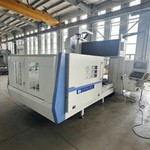


CNC Lathe Machine
What is CNC Lathe Machine?
CNC lathe is a mechanical setup that is integrated with computerized numeric control (CNC) for automated precision machining. This machine can be designed in two types such as flat-bed CNC lathe and slant bed CNC lathe machines. These machines feature multiple components and mechanical linkages that are automated using CNC programs.
Why Choose Us
Compliant With Standards
Most of our products comply with CE and EAC standards
OEM and ODM Orders
We also accept OEM and ODM orders and look for agents around the world
Excellent Service
Dedicated to producing higher intelligence, higher quality machine tools, and excellent after-sales service
High Quality Service
Make machines simpler, smarter, and smarter, always online, always with you, always serving you.


How Does a Cnc Lathe Machine Work?
Machine bed: The machine bed serves as the base of the machine on which all other components are mounted.
Main spindle: The main spindle is made up of a spindle assembly and spindle drive system that includes motors, gears and the chuck. The main spindle receives the material and drives it through the process.
Sub-spindle: Sub-spindles, while separate from the main spindle, work in tandem with the main spindle to perform additional cutting operations to improve efficiency of the production process.
Chuck: Attached to the main spindle, the chuck grips the workpiece and rotates the workpiece throughout the process.
Guide way: The guide way allows the main spindle and workpiece to move vertically and horizontally during the cutting process.
Headstock: The headstock has the main motor to drive the main spindle and can be adjusted for high torque at low speed.
Tailstock: The tailstock provides extra support for the other end of the component being produced. By providing force on the other end, the process can be completed smoothly.
Tool turret: The tool turret consists of a number of different cutting tools that are used for a specific component.
CNC controller: All CNC programs are stored inside the controller, which allows machinists to start and stop the machine, move axes, apply new programs and have overall control over the production process.
1. Headstock
The lathe headstock is the power behind the machine. As one of the most identifiable components of a CNC lathe, the headstock holds the workpiece and keeps it centered on the machine’s axis. The dimensions of the headstock will dictate the lathe’s “swing.” Swing is the maximum diameter of any (pre-machined) workpiece which can fit in the lathe. Though most tasks will not be so large, a machine with a big swing is sometimes very useful.
2. CNC Lathe Bed
The bed of a lathe is the chassis that holds everything together. It is generally a beam that runs the length of the machine and supports all of the functional subassemblies. The bed must be stiff enough that it does not experience measurable distortion, even under the most extreme usage conditions.
3. Chuck
The chuck is perhaps the most critical component of a lathe. It clamps the workpiece at the center of rotation and allows easy loading and unloading.
4. Tailstock
The tailstock of a lathe is critical in several tasks. It stands opposite the headstock on the same axis of rotation and can firmly lock onto the workpiece’s far end. The extra support can be important to resist significant operating loads. Alternatively, a drill bit may be mounted to the tailstock to drill into the workpiece’s rotational axis.
5. Tailstock Quill
The quill portion of the tailstock is what grips the Morse taper. It is an externally cylindrical mount that allows chucks, drills, etc to be fitted to the tailstock. The quill is the movable part that can be driven towards the workpiece for drilling or center-stabilization purposes.
6. Foot Switch or Foot Pedals
Foot switches or foot pedals allow the operator to directly control machine setup or unload functions while their hands are busy in the machine. These pedals can control several functions such as: opening/closing of the chuck (if it is hydraulically or pneumatically operated), positioning of the tailstock (for centering and support setup), and acting as an emergency stop to avoid programming errors and/or accidents.
7. CNC Control Panel
The operator controls on a CNC lathe typically consist of two parts: the machine panel and the control panel. The machine panel allows the operator to adjust the tool's operational characteristics and cutter position. It is used to manually jog (make small alterations to the position of) the machine's driven axes. The control panel, on the other hand, can be used to enter programs into memory and to edit or alter programs already in memory. This part of the operation is displayed on the integrated screen and shows the G-code being entered or modified.
8. Tool Turret
The tool turret is the business end of the CNC lathe. Various tools are placed into an operational position and their cutting faces are precisely logged in the machine setup. Each tool in the turret can be rotated one at a time into the cutting position. This feature differs from manual (turret or capstan) lathes in that the tool selection and positioning are performed automatically.
Applications Of CNC Lathe Machine
Cnc Turning Machining
CNC turning machining is performed over a cylindrical or spherical workpiece. It enables the removal of material in the circular or around the axis cutting motion. In this process, the cylindrical or circular workpiece is mounted in the chuck which is rotated by a motorized spindle. The cutting tool is mounted on the tool post. Based on the CNC program set in the control panel, the turning takes place.
CNC Drilling
CNC drilling can be performed in different ways using CNC lathe machines. Through-hole drilling, counter-bore, miniature drilling, etc can be performed using these machines.
Feature Formation
Circular groves can be formed using CNC lathes. Features like grooves, slits, notches, fillets, etc can be formed using the CNC lathes, provided the surface remains cylindrical or spherical.
Surface Finishing
CNC lathes can be used for surface finishing and attaining dimensional accuracy and stability of products.
What Are The Types Of CNC Lathe Machine Processes?
Turning: A cutting tool is mounted on a moving slide. As the workpiece spins, the cutting tool is pressed against it. The slide moves up and down along the workpiece, as well as away from or closer to the center line. Turning processes are usually accessed when large amounts of material need to be quickly removed from the workpiece.
Facing: In facing, a single-point tool moves along the workpiece, removing a thinner layer of material. This process produces flat, smooth surfaces at the ends of the workpiece.
Thread Cutting: Here, the tool moves along the outside of a workpiece to create threads in the outer surface. These threads may be cut to any length or pitch.
Grooving: The tool moves along the workpiece, gradually cutting a groove into it which matches the tool’s width. Multiple passes may be required to achieve a wider groove or add various geometries.
Drilling: This process uses a drill to make holes in the workpiece.
Boring: Boring is often used after drilling to either make the hole larger, or to achieve more precise dimensions. It can also be used to achieve features such as tapers, steps, and contours.
Reaming: Also employed after drilling, reaming removes a precise amount of material in order to achieve a more accurate diameter and a smooth internal finish.
Tapping: This cuts a thread inside the hole, so a screw can be threaded into it.
Tapering: A conical shape is produced on the workpiece.
Parting: This process separates the workpiece after machining.
Knurling: Here, an indentation is made on the edge of the workpiece.
Chamfering: This removes burrs and produces bevels at the ends of the workpiece, to achieve a better look.
Operational Processes For CNC Lathe Machine
Cutting involves separating large amounts of material from a workpiece with a sharp-edged cutting tool.
Deformation involves physically changing the shape of a workpiece by removing material from it.
Drilling entails fitting a lathe with a drill bit that presses into the workpiece and digging a circular hole that can support bolts, screws, or other fasteners.
Facing is a standard CNC lathe machine operation involving cutting the workpiece’s surface with a tool that’s secured on the machine’s mounting system; this tool cuts away uniform amounts of material from the surface of a workpiece.
Knurling involves using a roller with raised spikes that pierce holes into a workpiece’s surface to make it more attractive through texturing.
Sanding is used for finishing, where workpieces are rotated against a tool bit attached to a CNC lathe machine, with parts utilizing abrasive material like sandpaper to smooth the surface by removing tiny amounts of material from the surface.
Turning is when a workpiece “turns” or rotates against a stationary cutting tool, one of the CNC lathe machine’s parts.

Advantages Of a CNC Lathe Machine
Speed And Efficiency
CNC lathes epitomise efficiency in machining processes. Their design allows for swift operations, significantly reducing production time while maintaining impeccable precision. This advantage is particularly crucial in meeting tight deadlines without compromising quality and streamlining manufacturing workflows with their rapid machining capabilities. By swiftly and precisely executing machining tasks, these machines optimise production schedules, enabling faster completion of projects. Their consistency ensures minimal rework, reducing time spent on rectifying errors and enhancing overall output.
Workspace Cleanliness
In our collection of CNC lathe machines, we are pleased to direct your attention to the ingenious slanted configuration of CMZ slant bed lathes. This design doesn't merely enhance machining but also contributes to a cleaner workspace. By facilitating superior chip evacuation during the machining process, these lathes mitigate clutter caused by chips and waste materials. This feature not only promotes a safer environment but also minimises the time spent on post-machining clean-up, enhancing overall operational efficiency. Proactive chip management in CNC lathe machines minimises the risk of accidents and injuries, prioritising the well-being of operators and maintaining a secure workplace.
Unparalleled Accuracy
The hallmark of CMZ slant bed lathes lies in their ability to deliver unrivalled precision. Engineers and manufacturers rely on these machines for their exceptional accuracy in shaping and machining parts. This accuracy ensures consistency across batches and aids in achieving intricate designs or tight tolerances demanded by various industries.
Certifications


Our Factory
We have a general investment of 300 million yuan and covers an area of more than 120 thousand square meters, has more than one hundred sets of advanced equipment, annual production capacity over 3600 sets of machines, comprising more than thirty-five types and over fifty models. As a professional CNC lathe machine, CNC Veritical machining center, CNC gantry machine, band saw machine, bending machine supplier, We have dedicated ourselves to the field of machine tool manufacturing, we have built a modern quality management system which is in strict accordance with international standards, committed to produce a higher intelligent and higher quality machines and good after-sales services. We have exported our machines to more than 50 countries such as Russia, Belarus, East Europe, Egypt, Algeria, South Africa, Indonesia, Vietnam, Argentina, Mexico. We are also taking OEM & ODM orders and looking for agents all over the world, most of our products have got CE & EAC standards. Welcome to ZHONGXIN and establish a good cooperation and create a bright future together. ZHONGXIN, make the machines more easier, intelligent, and smarter, always online, always with you, and always for you!
