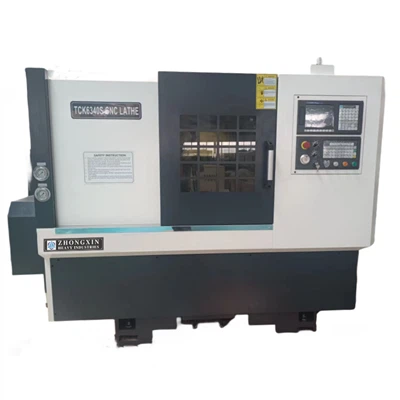
Hey there! I'm a supplier of New Slant Bed Lathes, and today I wanna chat about the Y - axis function in these awesome machines.
First off, let's get a basic understanding of what a slant bed lathe is. A slant bed lathe is a type of lathe where the bed is inclined at an angle, usually around 45 degrees. This design offers several advantages, like better chip evacuation, improved rigidity, and easier access to the cutting area. But when we talk about the Y - axis function, it takes things to a whole new level.
The Y - axis in a New Slant Bed Lathe adds an extra dimension to the machining capabilities. Traditionally, lathes operate mainly on the X and Z axes. The X - axis controls the cross - feed, which is the movement of the cutting tool towards or away from the workpiece. The Z - axis is responsible for the longitudinal movement, along the length of the workpiece. But with the addition of the Y - axis, we can perform more complex machining operations.
One of the key benefits of the Y - axis function is the ability to create off - center features. For example, if you need to drill a hole that's not in the center of the workpiece, the Y - axis allows the cutting tool to move in that perpendicular direction to the X and Z axes. This is super useful in industries where precision parts with non - centered features are required, such as the aerospace and automotive industries.
In aerospace, components often need to have very specific holes and pockets in precise locations. The Y - axis on a New Slant Bed Lathe enables us to accurately machine these features, ensuring that the parts meet the strict quality and performance standards. Similarly, in the automotive industry, parts like engine blocks and transmission components may require off - center holes for various functions.
Another advantage is the ability to perform milling operations on a lathe. With the Y - axis, we can move the cutting tool in a way that mimics the movement of a milling machine. This means that we can create flat surfaces, slots, and even complex profiles on the workpiece without having to transfer it to a separate milling machine. This not only saves time but also reduces the chances of errors that can occur during the transfer process.
Let's take a look at some of our products that come with the Y - axis function. We have the Swiss Turn Lathe, which is known for its high precision and versatility. The Y - axis on this machine allows for extremely accurate machining of small and complex parts, making it a great choice for the medical device and electronics industries.
Our Precision CNC Lathe also features the Y - axis function. This lathe is designed for high - volume production of precision parts. The Y - axis enhances its capabilities, allowing for faster and more efficient machining. Whether you're producing shafts, bushings, or other cylindrical parts, this lathe can handle it with ease.
And then there's the Ck6140 CNC Lathe. This is a popular choice for many workshops. The Y - axis on the Ck6140 enables a wide range of machining operations, from simple turning to more complex milling and drilling. It's a reliable and cost - effective option for businesses looking to upgrade their machining capabilities.
Now, let's talk about how the Y - axis function is controlled. In modern New Slant Bed Lathes, the Y - axis is typically controlled by a computer numerical control (CNC) system. This system allows for precise programming of the toolpath, ensuring that the cutting tool moves exactly where it needs to go. Operators can input the desired coordinates and machining parameters into the CNC system, and the lathe will execute the operation with high accuracy.
The programming of the Y - axis can be a bit more complex compared to the X and Z axes, but with the right training and experience, operators can quickly master it. Many CNC systems come with user - friendly interfaces and programming software that make it easier to create and edit toolpaths.
In addition to the technical aspects, the Y - axis function also has an impact on the overall productivity of a workshop. By being able to perform more complex operations on a single machine, businesses can reduce the number of setups and the time spent transferring parts between different machines. This leads to increased efficiency and lower production costs.
However, it's important to note that the Y - axis function also requires proper maintenance and calibration. Just like any other component of a lathe, the Y - axis needs to be kept in good working condition to ensure accurate machining. Regular checks of the linear guides, ball screws, and servo motors are essential to prevent any issues that could affect the performance of the Y - axis.
If you're in the market for a New Slant Bed Lathe with the Y - axis function, we're here to help. We offer a wide range of high - quality lathes that are designed to meet the needs of different industries. Our team of experts can provide you with all the information you need about the Y - axis function and how it can benefit your business. Whether you're a small workshop or a large manufacturing company, we have the right solution for you.


So, if you're interested in learning more about our products or discussing your specific machining requirements, don't hesitate to get in touch. We're always happy to have a chat and see how we can help you take your machining capabilities to the next level.
References
- "CNC Machining Handbook"
- "Advanced Lathe Operations Manual"