



Swiss Turn Lathe
What is Swiss Turn Lathe?
A Swiss turn lathe, also known as a Swiss CNC machine or Swiss automatic lathe, is a modern machine that can quickly and accurately produce small parts. It's a type of turning machine that uses a guide bushing to feed stock through the machine, which supports the material and allows the cutting tool to cut close to the bushing.
Why Choose Us
Compliant With Standards
Most of our products comply with CE and EAC standards
OEM and ODM Orders
We also accept OEM and ODM orders and look for agents around the world
Excellent Service
Dedicated to producing higher intelligence, higher quality machine tools, and excellent after-sales service
High Quality Service
Make machines simpler, smarter, and smarter, always online, always with you, always serving you.

A CNC machine tool is a processing machine that utilizes a CNC system to operate the machine tool for processing actions. Unlike ordinary machine tools, CNC machine tools do not need to manually manufacture replacement molds and fixtures, no need for frequent manual adjustment of the machine tool

CNC lathe clamping device, chuck is *, although now there is a pneumatic chuck, but the pneumatic chuck is limited to small pieces of rapid processing, chuck naturally become irreplaceable products.

CK6150 CNC lathe Integral arch and bridge type body, one-piece molding structure is stable and rigid, standard equipped with manual tail stock and 250 manual chuck

Frequency conversion step less speed regulation
With servo system
Four position electric turret

CK6132 CNC lathe is mainly used for processing all kinds of shaft and disk parts, can turn all kinds of threads, arcs, cones and internal and external surfaces of rotating bodies, and can meet the speed demand of high-speed chip-cutting of ferrous and non-ferrous metals.

CNC Turning And Milling Center
The workpiece should be clamped with pressure plate, screws or tools. The use of a stream of wrenches are not allowed to add casing, so as not to slip off injuries;

The use of horizontal cnc lathe machine can be said to be very common, in various industries and fields can see its figure. It plays a very important role in the construction of modernization. And with the improvement of people's needs, the requirements for it are also higher and higher. With the development of science and technological progress, the new CNC machine tools were born.
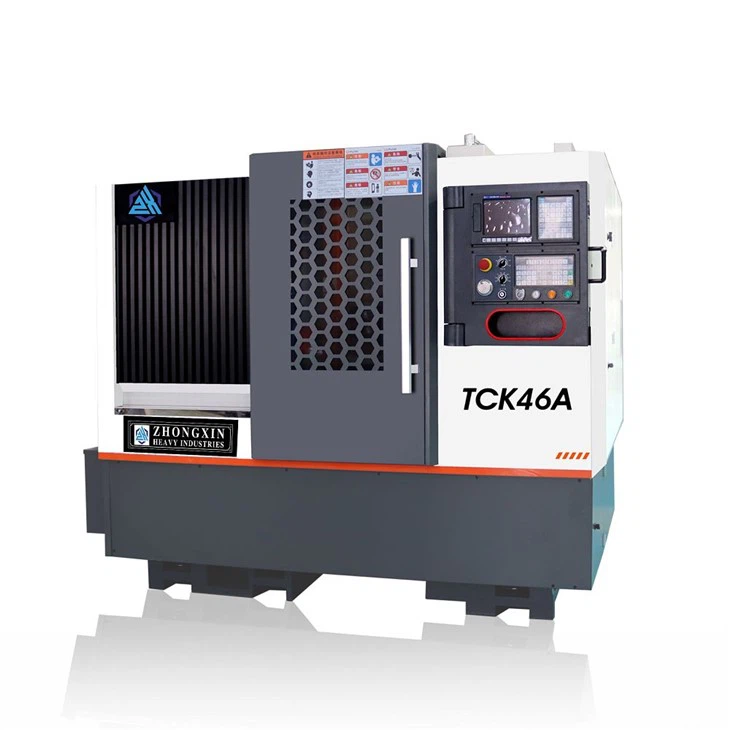
In modern industrial production, all types of lathes are *. Since the bed of horizontal slant bed lathe is inclined and has a large bearing section, it has good rigidity and vibration damping, and can ensure high-precision machining.

This drum type tool magazine structure is simple, more applications, suitable for less capacity of the tool magazine. In order to increase the utilization rate of the tool magazine space.
In traditional lathes with fixed headstocks, a work component will be secured in a collet or chuck that will extend into the machine's enclosure as a cantilever. The other option is to use a tailstock to anchor it on one end. The Swiss lathes are distinguished from other models by their moveable headstock.
This indicates that the bar-stock will be secured onto the headstock after passing through the chucking collet. This bar then enters the tooling area via the guide bushing, which locates it radially during machining. After that, the headstock moves in a steady back-and-forth manner in a z-direction, dragging the bar behind it.
Turning tools placed on the gang slides will come into contact with this bar, which is located near the guide bushing. The feed needed for cutting action is provided by the bar's motion. The gang slides will contain the holders for fixed single-point tools and any other tools. They can even handle live tooling. Several of these machines have back-working tool stations and supplementary spindles, as well as a turret or more that can hold extra tools.
The Basic Anatomy Of a Swiss Lathe
The Main Spindle
Just like with a conventional CNC turning machine, Swiss-type lathes utilize a main spindle as the primary rotating element which essentially brings the machine to life. The main spindle rigidly holds the workpiece as it spins at high speeds – roughly between 100 and 10,000 rpm. This rotational motion is what provides the kinetic energy that the cutting tools use to remove material through friction and precisely shape the workpiece.
Tool Headstock
The tool headstock houses the cutting tools, responsible for their movement and precise positioning along the workpiece. Swiss lathes utilize multi-tool stations, allowing for the simultaneous use of numerous tools to produce complex machining features and/or reduce the number of required cycles. Unique to Swiss turning machines is a sliding headstock, as opposed to the fixed headstock of conventional lathes. The moveable headstock slides along the workpiece with the guide bushing, allowing for much more rigid and precise workholding.
Guide Bushing
The guide bushing is the other main feature that sets Swiss-type lathes apart from conventional CNC turning machines. While standard lathes only support the workpiece at either end (i.e. potentially a relatively far distance from the cutting tool), Swiss lathes use a moving guide bushing that supports and guides the material as it's machined. The sliding guide bushing is especially useful when working with long and slender workpieces, as well as for small parts and micro-machining, ensuring stability and precision down to extremely tight tolerances.
Cross-Slide
The cross-slide moves perpendicular to the main spindle and is responsible for the lateral movement of the cutting tools. Designed to be extremely smooth and rigid, the cross-slide enables precise control over the Swiss machining process and contributes to our overall accuracy and repeatability.
Turret
The turret is a tool-carrying apparatus that holds multiple cutting tools simultaneously, allowing for quick change-outs to streamlining the machining process. As the name suggests, the turret rotates and indexes to bring the desired tool into position for machining operations. This feature enhances the efficiency of the Swiss lathe by reducing tool change times, and ensures accuracy/repeatability by eliminating the need for multiple setups.
Sub-Spindle
More advanced Swiss turning systems are equipped with a sub-spindle that is located opposite of the main spindle. The sub-spindle allows us to machine the backside of the workpiece simultaneously as we carry out the primary machining operations. Not only does this reduce cycle time, it also allows us to produce more complex and intricate parts on a single setup, further guaranteeing precision and repeatability.
Bar Feeder
Modern Swiss lathes generally incorporate an automatic bar feeder that supplies raw material to the machine – usually in the form of a bar stock or wire. Automatic bar feeders streamline the manufacturing process, allowing us to continuously machine your products without the need for manual intervention between separate workpieces.
Coolant System
To dissipate heat generated during machining and to lubricate cutting tools, advanced coolant systems are integrated into Swiss lathes. This system helps maintain tool integrity while improving the quality and consistency of the end products.
Control Panel
A CNC control panel essentially functions as the brain of the machine: the interface through which our operators input all machining parameters and required tool paths. Control panels play a crucial role in programming and operation of CNC Swiss lathes, providing much higher efficiency and repeatability via computer automation.
Benefits Of Swiss Turn Lathe
Ability to Produce Small, Complex Parts
Old machines are able to create small, complex parts. However, the machines have limited capabilities. It can also take the machine a long time to produce the parts. The Swiss lathe is able to create complicated parts more effectively and efficiently.
Reduced Cycle Times
The Swiss Lathe is able to reduce cycle times, which allows for greater efficiency. The software that is set up also allows the machine to work more efficiently. The programmers will watch a simulation, which makes it easier to make the necessary corrections. That is why the parts are able to be machined more quickly.
Single Process Machining
Many people purchase a CNC swiss lathe from a custom CNC machine shop because several tools can be placed on the Swiss lathe at one time. This allows for single process machining.
Lights Out Capability
The Swiss lathe machine can perform without anyone manning it. That is why it is ideal for large outdoors. That is why Sanford custom CNC machining is a great choice for boosting productivity and efficiency.
Core Features Of Swiss Lathes
Intelligent Chucking And Precision
One of the standout features of our Swiss lathes is intelligent chucking. This mechanism ensures that materials are held firmly yet flexibly, adapting to the specific requirements of each machining task. This, combined with high precision mode, allows for the machining of components with incredibly tight tolerances, a necessity in industries like aerospace and medical device manufacturing.
High Productivity and Efficiency
The efficiency of Swiss lathes is unmatched. With capabilities such as rapid tool change and variable frequency turning, our machines minimize downtime and increase throughput. This efficiency is a game-changer for manufacturers aiming to scale their production without compromising quality.

Swiss Lathes Are Used In Various Manufacturing Industries
Swiss lathes are often used in manufacturing because of their precision and accuracy. They can be used to create various objects commonly used in the following industries:
The oil and gas industry uses nozzles, pins, washers, and fasteners made from swiss lathes.
In the medical industry, swiss lathes are used to create small, delicate parts for implants and other devices.
The aerospace industry uses swiss lathes to create precision parts for aircraft engines, missiles, and rockets.
The automotive industry uses swiss lathes to create engine parts and other components.
Certifications


Our Factory
We have a general investment of 300 million yuan and covers an area of more than 120 thousand square meters, has more than one hundred sets of advanced equipment, annual production capacity over 3600 sets of machines, comprising more than thirty-five types and over fifty models. As a professional CNC lathe machine, CNC Veritical machining center, CNC gantry machine, band saw machine, bending machine supplier, We have dedicated ourselves to the field of machine tool manufacturing, we have built a modern quality management system which is in strict accordance with international standards, committed to produce a higher intelligent and higher quality machines and good after-sales services. We have exported our machines to more than 50 countries such as Russia, Belarus, East Europe, Egypt, Algeria, South Africa, Indonesia, Vietnam, Argentina, Mexico. We are also taking OEM & ODM orders and looking for agents all over the world, most of our products have got CE & EAC standards. Welcome to ZHONGXIN and establish a good cooperation and create a bright future together. ZHONGXIN, make the machines more easier, intelligent, and smarter, always online, always with you, and always for you!

FAQ
Hot Tags: swiss turn lathe, China swiss turn lathe manufacturers, suppliers, factory, cnc lathe for optical component machining, cnc lathe for just in time production, cnc lathe for shaping, cnc lathe for engraving, cnc lathe for fitting machining, cnc lathe for precise dimension control in machining
Previous
Best Small Cnc LathesYou Might Also Like



Send Inquiry