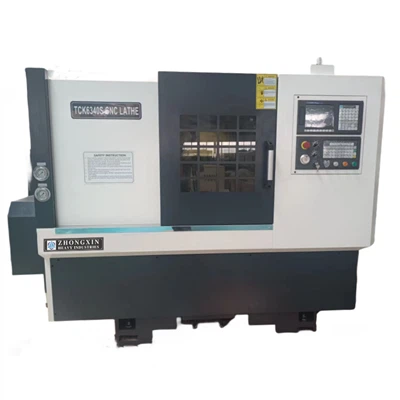
In the manufacturing industry, the demand for high - precision and efficient machining processes is constantly growing. Hard turning, a process of machining hardened materials, has emerged as a crucial technique. As a supplier of CNC lathe machines, I often receive inquiries about whether our CNC lathe machines can be used for hard turning. In this blog, I will delve into this topic, exploring the capabilities of CNC lathe machines in hard turning, the factors to consider, and the benefits it offers.
Understanding Hard Turning
Hard turning refers to the process of machining materials with a hardness of 45 HRC (Rockwell hardness scale) or higher. Traditionally, grinding was the primary method for finishing hardened parts. However, hard turning has gained popularity due to its potential to offer comparable surface finish and dimensional accuracy while providing several advantages in terms of cost, productivity, and flexibility.
The process involves using a single - point cutting tool on a lathe to remove material from a rotating workpiece. This is in contrast to grinding, which uses an abrasive wheel. Hard turning can be used for a variety of applications, including the production of automotive components, aerospace parts, and tooling.
Can a CNC Lathe Machine be Used for Hard Turning?
The short answer is yes, a CNC lathe machine can be used for hard turning. Modern CNC lathes are equipped with advanced control systems, high - power spindles, and rigid machine structures that make them suitable for the challenges of hard turning.
Machine Rigidity
One of the key requirements for hard turning is machine rigidity. When machining hardened materials, the cutting forces are significantly higher compared to machining softer materials. A rigid CNC lathe can withstand these forces without excessive vibration, which is crucial for maintaining dimensional accuracy and surface finish. Our New Slant Bed Lathe is designed with a robust structure that provides excellent rigidity, making it well - suited for hard turning operations.
Spindle Power and Torque
Hard turning requires sufficient spindle power and torque to drive the cutting process. The high hardness of the workpiece means that more power is needed to remove material effectively. Our CNC lathe machines are equipped with high - power spindles that can deliver the necessary torque at different speeds. For example, our Horizontal CNC Lathe Machine has a powerful spindle motor that can handle the demands of hard turning operations, ensuring smooth and efficient machining.
Tooling and Cutting Parameters
In addition to the machine itself, the choice of tooling and cutting parameters is crucial for successful hard turning on a CNC lathe. Specialized cutting tools, such as cubic boron nitride (CBN) or polycrystalline diamond (PCD) inserts, are commonly used for hard turning due to their high hardness and wear resistance.
The cutting parameters, including cutting speed, feed rate, and depth of cut, need to be carefully selected based on the workpiece material, tool material, and machine capabilities. Our technical support team can provide guidance on selecting the appropriate tooling and optimizing the cutting parameters for hard turning applications.
Advantages of Using a CNC Lathe for Hard Turning
Cost - Effectiveness
Hard turning on a CNC lathe can be more cost - effective than grinding in many cases. Grinding requires expensive grinding wheels and specialized equipment, and the process is often time - consuming. In contrast, hard turning on a CNC lathe can reduce setup time and tooling costs. The ability to perform multiple operations on a single machine also eliminates the need for additional equipment, further reducing costs.
Productivity
CNC lathes offer high productivity in hard turning operations. The automated nature of CNC machining allows for continuous and precise cutting, reducing human error and increasing the production rate. With the ability to program complex machining paths, CNC lathes can produce parts with high accuracy and repeatability in a shorter time compared to manual machining methods.
Flexibility
CNC lathes provide greater flexibility in hard turning. They can easily adapt to different part geometries and machining requirements. By simply changing the CNC program, the same machine can be used to produce a variety of parts. This is particularly beneficial for small - to - medium - batch production, where quick changeovers are required. Our Horizontal Slant Bed Lathe is designed with this flexibility in mind, allowing for easy adjustment to different hard turning applications.
Factors to Consider When Using a CNC Lathe for Hard Turning
Workpiece Material
The type of workpiece material has a significant impact on the hard turning process. Different materials have different hardness levels, microstructures, and machinability characteristics. For example, hardened steels, cast irons, and superalloys all require different cutting strategies and tooling. It is important to understand the properties of the workpiece material before starting the hard turning process.
Tool Wear
Tool wear is a major concern in hard turning. The high hardness of the workpiece can cause rapid wear of the cutting tool, which can affect the surface finish and dimensional accuracy of the part. Regular tool inspection and replacement are necessary to ensure consistent quality. Using high - quality cutting tools and optimizing the cutting parameters can help reduce tool wear.
Surface Finish and Dimensional Accuracy
Achieving the desired surface finish and dimensional accuracy is crucial in hard turning. The cutting parameters, tool geometry, and machine rigidity all play a role in determining the final quality of the part. Fine - tuning these factors through trial and error or using advanced machining simulation software can help achieve the required surface finish and dimensional accuracy.
Conclusion
In conclusion, a CNC lathe machine can indeed be used for hard turning. With the right machine features, tooling, and cutting parameters, CNC lathes offer a cost - effective, productive, and flexible solution for machining hardened materials. As a supplier of CNC lathe machines, we are committed to providing high - quality machines and technical support to help our customers succeed in their hard turning applications.
If you are interested in using our CNC lathe machines for hard turning or have any questions about our products, please feel free to contact us for further discussion and procurement negotiation. We look forward to working with you to meet your machining needs.


References
- Boothroyd, G., & Knight, W. A. (2006). Fundamentals of machining and machine tools. CRC Press.
- Kalpakjian, S., & Schmid, S. R. (2010). Manufacturing engineering and technology. Pearson Prentice Hall.
- Trent, E. M., & Wright, P. K. (2000). Metal cutting. Butterworth - Heinemann.